










































Financial Forecasting for mHealth Partnerships for Behavior Change
Palladium
This mHealth presentation for the International SBCC Summit 2016, Addis Ababa, Ethiopia, February 8-10, discusses scalability and sustainability in an mHealth nutrition messaging programme delivered through text-based (SMS) or voice-based (IVR) messages
It first explains the structure of the GSM Association (Groupe Speciale Mobile Association), a global trade association representing over 800 mobile network operators worldwide and the Mobile for Development Foundation, their goals being:
- "Partnering with African mobile network operators
- Trying to create a sustainable, scalable mHealth program
- Targeting vulnerable women and children with nutrition BCC messages"
The presentation describes the widespread nature of mHealth pilot projects in 8 focus countries: Ghana, Malawi, Mozambique, Nigeria, Rwanda, Tanzania, Uganda, Zambia, where there are 250 mHealth initiatives - few operating at national scale or with financial sustainability, even though the potential of mHealth is recognised by stakeholders.
As stated here, “mNutrition” is under development as a sustainable model of using mobile messaging for health (nutrition) BCC messages. Sustainability and national scalability are being built in through:
- "Involving mobile network operators from the beginning
- Developing a business case for delivering free or reduced cost health BCC messages via mobile
- Free messages serve as a lead-in for other products and services and improves user satisfaction."
Characteristics include: voluntary registration to provide basic information such as expected delivery date in pregnancy or age of child and preference of text-based (SMS) or voice-based (IVR) messages. The nutritional messaging is stage-based (from gestation until the child is two years old), weekly, and free or very reduced in cost.
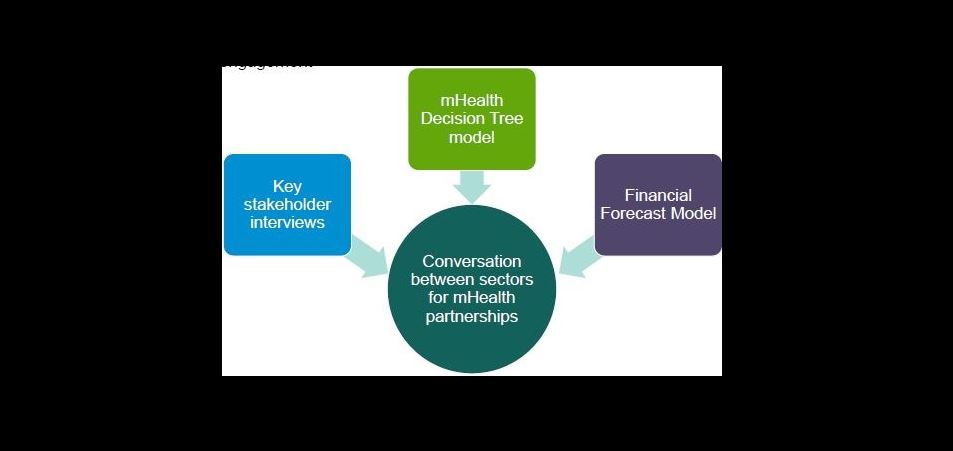
Potential partners include: the government, mobile network operators, non-governmental organisations, and international funders, each with its own resources, experience, connections, and funding sources. The presenter's organisation, Palladium, offers engagement of stakeholders and "health and economic proof points" in support of mNutrition launch and product concept development with sustainability and scale as goals. It uses the model illustrated in the image, the steps of which are elaborated through:
- Decision tree: estimating programme reach, example: Zambia
- Financial Forecast Model (FFM)
- A graph showing results that provide two scenarios of estimated annual cost and five-year cost in Zambia
A graph showing a country comparison of cost per subscriber.
The FFM adaptability is discussed, and sustainability through public-private partnerships is illustrated.
Email from Sindri Kinnier to The Communication Initiative on February 8 2016.
- Log in to post comments