










































Relationship between Citizens' Health Engagement and Intention to Take the COVID-19 Vaccine in Italy: A Mediation Analysis
EngageMinds HUB - Consumer, Food & Health Engagement Research Center (Graffigna, Palamenghi, Barello); Università Cattolica del Sacro Cuore (Graffigna, Palamenghi, Boccia, Barello); Fondazione Policlinico Universitario A. Gemelli IRCCS (Boccia)
"Clinical and organizational evidence about the value of engaging patients in healthcare is growing. Our study suggests broadening this scientific debate to vaccine-related attitudes as well..."
Efforts being undertaken around the world at the time of this writing to develop an effective vaccine against SARS CoV-2 might be challenged by vaccine hesitancy, which is a difficulty in accepting or an outright refusal of vaccines, despite their availability. Conducted in Italy, this study sought to understand the interrelatedness of various psychosocial factors - health engagement, perceived COVID-19 susceptibility and severity, and general vaccine-related attitudes - that might hamper individual motivation to undertake vaccination against COVID-19. This information could guide planning of personalised counselling and educational initiatives that may cultivate a more positive approach to disease prevention and vaccination behaviours among adult Italians.
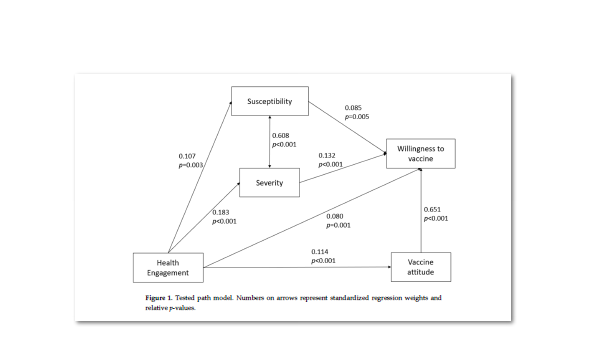
To that end, on a sample of 1,004 Italian adults who completed a survey during the early days of the Italian reopening after the lockdown, the researchers implemented a path model to test the impact of health engagement - an individual's psychological attitude towards their health promotion and self-management - on the willingness to vaccinate against SARS CoV-2 and to explore whether this relationship is direct or mediated by general attitude towards vaccines and risk perception. Moreover, they tested the model across gender and 3 age groups.
Among the sample, who ranged in age between 18 and 70 years, 15.3% said the probability of them getting an eventual COVID-19 vaccine was either "not likely at all" or "unlikely", and 26.2% answered that it is "not likely or unlikely". Only 58.6% said they would "probably accept" the vaccine. This is in line with survey data from other western countries.
Furthermore, the results show that health engagement is positively related to the intention to vaccinate and that this relationship is partially mediated by general attitude towards vaccines. The model appears invariant across genders and partially invariant across age groups. In the middle-aged group, perceived susceptibility seemed to be a more impactful factor. Also, an inspection of direct, indirect, and total effects of health engagement on willingness to vaccinate across age groups suggested that among younger people, the relationship between these 2 variables seems to be proportionally more affected by the direct effect, while in elderly people, the effect is more strongly mediated by attitude towards vaccination.
For the researchers, these data corroborate the value of extending debates about patient engagement to the specific scope of vaccine intention. These data also suggest the opportunity to advance the understanding of psychological factors impacting on COVID-19 vaccine hesitancy by including the analysis of less contingent elements (i.e., not only the individual's current state of worry and perceived susceptibility to the disease), such as the individual's health engagement: a psychological dimension that could be modified with dedicated educational and counselling interventions.
Specifically, communication practitioners could explore how to foster a more positive psychological attitude towards health in the population, starting from school age. The goal would be to guide individuals in perceiving themselves as co-responsible for their own health. Furthermore, educating people to become more engaged in prevention may be the basis for nourishing a positive climate of partnership and collaboration between the healthcare system and its users, in all the different phases of the life cycle.
In addition to reinforcing the potential of educational campaigns that also include health engagement promotion to sustain future vaccination programmes, this research has shown that "studying and understanding social, demographic, and psychological determinants is fundamental for the success of the future national immunization plans, in order to better understand which groups in the population are more likely to refuse the vaccine, and on the other hand, which psychological levers can be used to increase willingness to vaccinate."
In conclusion, the study's findings "confirm the multiplicity and complexity of vaccine hesitancy determinants." Thus, the researchers argue that "future studies and interventions on this issue should be based on multifactorial health behavior models, including the promotion of a psychological commitment to health engagement."
Vaccines 2020, 8(4), 576; https://doi.org/10.3390/vaccines8040576.
- Log in to post comments