










































Taking an HPV Vaccine Research-Tested Intervention to Scale in a Clinical Setting
University of California (Hopfer); REAL Prevention (Ray, Hecht, Miller-DayMiller-Day); Saint Louis University (Belue); Indiana University School of Medicine (Zimet); The George Washington University, Milken Institute School of Public Health (Evans); St. Andrew Development (McKee)
This article describes the process of adapting a National Cancer Institute (NCI) research-tested intervention programme (RTIP) for human papillomavirus (HPV) vaccination, "Women's Stories", for implementation in Planned Parenthood (PP) community clinics in the United States (US). Its premise is that RTIPs are seldom ready for widespread use; adapting them to clinical settings demands a user-centred and iterative approach that often requires additional development to take them to scale.
Women's Stories encouraged HPV vaccination among young adult college women ages 18-26 using video-based vaccine decision stories or narratives. The intervention was developed based on Narrative Engagement Theory (NET), which emphasises eliciting health content from and with the intended audience. A video was developed portraying 5 prototypical vaccine decision stories: a susceptibility story, a self-efficacy re-enactment, a story that speaks to the safety of the HPV vaccine, a cue-to-act dorm room discussion re-enactment, and a physician narrative disclosing a personal mother-daughter conversation. The intervention was tested in a randomised controlled trial (RCT) at one university, where it nearly doubled vaccination and was subsequently designated by NCI as an RTIP.
Then, the developers sought to adapt Women's Stories to reach underserved women who had lower rates of HPV vaccination and higher rates of late-stage cancer. This led to a partnership with PP that started with Planned Parenthood of Southeastern Pennsylvania (PPSP), which serves a diverse clientele through 12 clinics. Initial collaboration began with one PPSP clinic that serves predominantly African-American women, many of whom are Muslim. Moreover, the PPSP community clinic serves young adult women who may or may not be attending college (unlike the original intervention).
Five phases are described for the adaptation of content and the development of a health kiosk intervention delivery system. In brief
- Informant interviews were conducted with 26 PPSP clients ages 18-26, who were predominantly African American, to identify relevant vaccine decision narratives that would be perceived as authentic with local community members who attend the PPSP clinic. Eight vaccine decision stories were identified: (a) HPV (un)awareness, (b) wanting to stay healthy, (c) practitioners not mentioning HPV, (d) keeping female reproductive parts healthy, (e) including men in vaccine messages, (f) experiencing an abnormal Pap smear, and (g) cancer stories. Women were less familiar with health kiosks than they were with food kiosks used in gas stations or coffee shops, but they expressed a willingness and interest in using kiosks in the waiting room. In addition, 2 staff were interviewed to share their understanding of how the HPV burden is perceived among their patients and how HPV vaccine communication is handled at their clinic. They acknowledged that the biggest problem was the lack of opportunity to educate patients prior to exposure to infection, including men who come in for routine screening.
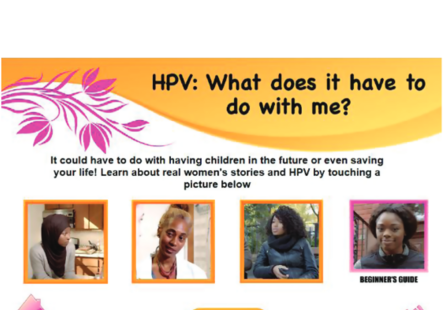
- Prototypical vaccine decision narratives were translated into 4 scripts for 1-minute video stories to be delivered on the kiosks: (a) a monologue in which a young woman retells a story about her cousin who was unaware of HPV and the vaccine; (b) a conversation in a kitchen between 2 female friends about the real risk and potential consequences of HPV; (c) a conversation on a park bench between a male and female friend about HPV and cancer risk for men; and (d) a physician strongly endorsing HPV vaccination to a young women when she shares she is considering becoming sexually active. The 4 scripts were pilot tested with 12 female PPSP clients aged 18-26; based on the findings, the scripts were revised.
- The research and technology development teams worked collaboratively to create a prototype. They integrated women's feedback: They wanted the kiosk to be visually informative with clear signage about what the kiosk was about (though the research team decided to avoid potential stigma by focusing the signage on women's health rather than HPV, which is a sexually transmitted infection, or STI); they said that bright colours should be used to attract attention and that the kiosk screen and menu should be interactive; and they wanted a female reproductive graphic.
- An independent researcher conducted a usability study of the health kiosk intervention product (N = 16). The kiosk was easily implemented, experienced no technical problems, and was evaluated positively by women using it.
- The kiosk was placed in the waiting room, and a research team member observed kiosk use and general behaviour over 2 days. No women used the kiosk on the first day. Even with prompting by the receptionist, the kiosk was not used. A PPSP research assistant spent an additional third day explaining that PPSP was testing the kiosk and looking for feedback. This approach was successful in getting clientele to use the kiosk.
Lessons learned and challenges in adapting prevention interventions to clinical settings are discussed. The research team stresses that, "For successfully adapting a prevention intervention to a new setting, evaluating all implementation phases ensures the greatest likelihood of successful adoption." For example, the challenge seemed to be overcoming clients' normative waiting room behaviour (e.g., sitting quietly and looking at their phones) despite their positive feedback and assurances they would use the kiosk. This lesson underscores the importance of including observational studies when adapting an intervention to a new setting, as what people say they are interested in and willing to do does not necessarily translate into actual behaviour.
Because of this study, the research team's plans include integrating the intervention into established clinical practices - in particular, integrating the intervention into check-in and exam room procedures to ensure its use (but, they will need to explore questions such as the impact this will have on patient wait times). They are also considering transforming the intervention into an independent e-learning module and an app that can be accessed on smartphones and tablets at the discretion of the individual.
In conclusion, successfully taking prevention interventions to scale in clinical settings involves: integrating the preventive health intervention into the existing clinic system, devoting considerable thought and time to the intervention delivery platform system, and designing the platform to reflect people's preferences for receiving health information and to take into account cultural sensitivities.
Translational Behavioral Medicine. 2018 Oct; 8(5): 745-752. doi: 10.1093/tbm/ibx066
- Log in to post comments