










































Advocacy for Stronger Infant and Young Child Feeding Policies and Programs for Decentralized Government Models: Lessons Learned From Alive & Thrive
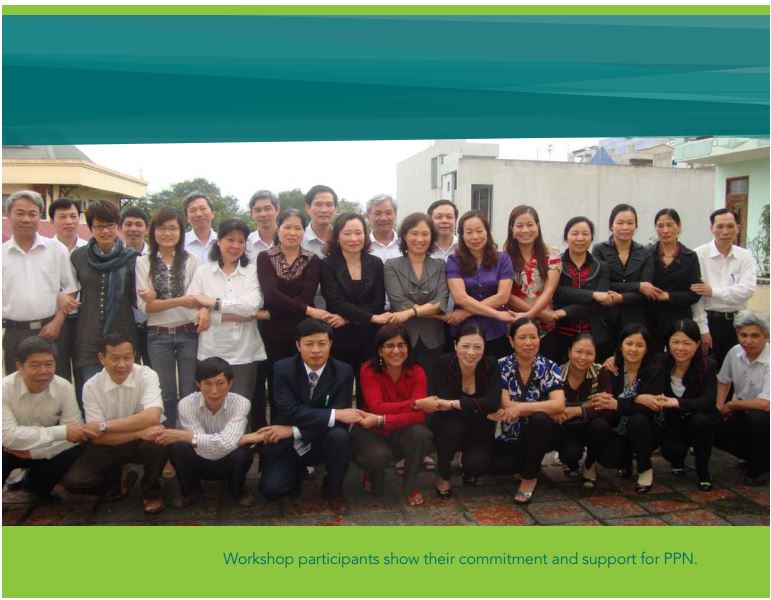
"With the [Vietnamese] government's move toward decentralization, Alive & Thrive identified an opportunity to influence localized nutrition policies through the annual Provincial Planning for Nutrition (PPN) process. PPN is an annual process in which provincial officials determine plans for nutrition-focused programming and then request funding allocations for the next year from the Ministry of Health and the Provincial People’s Committee to support implementation."
From Alive & Thrive's 2010-2014 work in Bangladesh, Ethiopia, and Viet Nam to reduce undernutrition and death caused by sub-optimal infant and young child feeding (IYCF) practices, this document describes how Alive & Thrive worked with "provincial authorities to build advocacy capacity among provincial officials to support their efforts to mobilize increased resources for nutrition, identify opportunities to better integrate infant and young child feeding into provincial planning and priorities, and strengthen compliance with the national code at provincial level." This description of IYCF's advocacy in Viet Nam is part of a series of documents on best practices and lessons learned in policy advocacy in three country contexts. (See related summaries below.)
The following were the broad goals that Alive & Thrive set out to achieve for its provincial planning for nutrition work:
- "Develop plans that are locally contextualized and evidence-based;
- Integrate nutrition programs with other sectors in their localities to enhance cross-sectoral resources and impact; and
- Build political support and mobilize increased resources for nutrition."
"Alive & Thrive’s opinion-leader research conducted in 2010 found that while the [Vietnamese] national nutrition program is strong at the central level, it is not adequately prioritized or funded within the provinces. Additionally, the research found that there was a lack of awareness among provincial leaders about Decree 21, Viet Nam's law to regulate the marketing of breastmilk substitutes. Subsequent research also found that key violations of the law were happening in provincial health centers. Alive & Thrive worked with provincial authorities to build advocacy capacity among provincial officials to support their efforts to mobilize increased resources for nutrition, identify opportunities to better integrate infant and young child feeding into provincial planning and priorities, and strengthen compliance with the national code at provincial level."
In partnership with Save the Children, Alive & Thrive introduced provincial level step-by-step guidance starting with consultative workshops, data synthesis and analysis for evidence-based planning, a list of child malnutrition prevention activities across provincial/city departments, and planning tools and guidelines with updated knowledge, skills, and experience to replace top-down planning. Technical support and funding was provided to the National Institute of Nutrition (NIN) to present new guidelines at regional workshops for all provinces; Alive & Thrive then helped operationalise the guidance through a series of workshops on consultation, resource mobilisation, and advocacy, and direct technical support. A chart on page 3 shows a timeline for partnerships, evidence base development, materials development, and consensus building.
Key results include:
- In annual evaluations across multiple indicators "(i.e., objectives, evidence-based planning, multi-sector integration, resource mobilization, contextual data use, feasibility, and creativity)", PPN quality improved.
- Awareness of IYCF increased "among local authority bodies, and led to stronger commitment and action."
- The NIN permitted "the use of National Target Program funds to support the Alive & Thrive models", and it disseminated Alive & Thrive communication materials. Alive & Thrive encouraged provinces to include the model in their provincial plans.
- Alive & Thrive trained Women’s Union (WU) members on code monitoring for the evaluation system of the government's Decree 21, and, in provinces where A&T worked, trained 70 percent of Commune Health Center’s staff and 20 percent of Village Health Workers on the national code (compared to 2 percent in non-Alive & Thrive areas).
The initiative found that:
- Engaging with the appropriate government partner from the start is essential: "Working across multiple sectors and mobilizing additional resources were the most challenging aspects of the PPN work" and included direct work with the political system and those with decision-making powers “to raise issue salience at the subnational level in the same manner as activities at the national level....This often requires investment of financial and technical resources."
- "Capacity is needed at the provincial level for policy change....Specifically, the planning process requires that provincial health planning teams have the ability, capacity, and authority to advocate with the provincial government for the inclusion of nutrition in the provincial plans and budgets."
- "Annual planning is an iterative process that requires regular adaptations. On an annual basis, activities and results were reviewed....Lessons emerged from feedback provided by provinces throughout the process, ranging from the need for more precise template materials, to ongoing technical assistance and feedback on nutrition plans once they are developed...."
- "Early engagement of government partners as full collaborators and implementers can offer opportunity for scale-up....[B]ecause NIN saw the value of the activity, they decided to brand the guidance as an official tool from NIN, providing it to all 63 provinces and encourage its use."
- "When possible, utilize opinion-leader research to guide strategy....These findings informed strategy, which involved developing the localized evidence-base and creating operational guidance to inform provincial leaders about the process, and to walk them through a step-by-step approach."
- "Key to success is the strong leadership of provincial health actors in nutrition activities."
- "Stunting reduction must be formalized as an objective in the provincial and district annual socioeconomic development resolution.... This is a fundamental step to ensure nutrition is prioritized for additional resources."
- "Simultaneous advocacy at national and sub-national levels is needed for success.... [P]rovincial outreach was complemented by a central level advocacy plan conducted in coordination with key partners."
Alive and Thrive website, June 6 2017. Image caption: Workshop participants show their commitment and support for PPN.
- Log in to post comments