










































Belonging to Socially Excluded Groups as a Predictor of Vaccine Hesitancy and Rejection
University of Haifa (Eshel, Marciano); Tel Aviv University (Kimhi, Adini)
"...in many cases the conspiracy beliefs expressed in cases of vaccine hesitancy and rejection may have a distinct social function. These responses can constitute channels of...objection..."
Despite the risk posed by COVID-19, a substantial number of individuals all over the world express vaccine hesitancy and vaccine rejection. Studies have explained COVID-19 vaccination hesitancy by pointing to people's mistrust in several key actors, including scientists, domestic healthcare professionals, and politicians, as well as to the role of conspiracy beliefs. This study investigates whether people who belong to social groups that are partly excluded, as well as those who deliberately choose to isolate themselves from society, are more likely to believe in conspiracy claims and more likely to reject the COVID-19 vaccine.
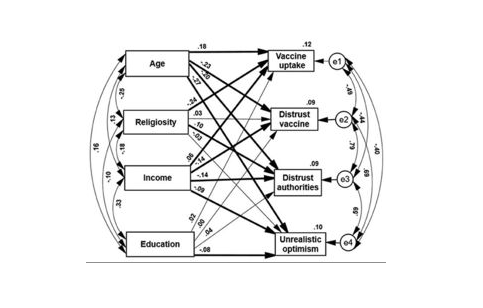
The study was conducted in Israel, where the government asks all inhabitants to show good citizenship and social responsibility by being vaccinated against COVID-19. In short, the paper's thesis is that individuals who belong to partly excluded social groups are more likely to express criticism of the integrity and the intentions of the authorities, as well as the pharmaceutical companies, and to feel that some conspiracy underlies the vaccination request. A third, indirect claim of conspiracy, which is phrased in terms of "unrealistic optimism", argues that the risk of COVID-19, as presented by the authorities, is highly exaggerated and unjustified. People who hold these beliefs may be more likely to respond negatively to the governmental request to complete the vaccination process.
The researchers envision that the individual sense of being segregated may be associated with belonging to one or more of four groups. Lower income and lower education levels are two attributes that may make people feel that their chances of improving their living conditions are rather scarce and that they are already partly excluded by the general society. Ultra-orthodox religiosity constitutes a third potential exclusion reason. The orthodox perspective in Israel is that being Jewish is mainly a matter of religion, while the majority of secular Jews tend to regard Judaism mainly as a matter of ancestry and culture. Therefore, ultra-orthodox individuals tend to live as a separate social entity, most likely in segregated and closed communities. Young adulthood, defined in this study as the 20-39 years' age range, may constitute a fourth reason for feeling excluded from "grownup society".
Jewish individuals from all over Israel (n = 2,002), 68% of whom had been vaccinated three times as requested by the government, responded between October 8-12 2021 to an online questionnaire. Responses indicate that three out of four social exclusion criteria - young adulthood, low level of income, and orthodox religiosity - negatively predict vaccine uptake and positively predict three types of reasoning for vaccine hesitancy: distrusting the vaccine, mistrusting the authorities, and unrealistic optimism. Young adulthood was the strongest predictor of vaccine rejection. Rather than explaining this finding by pointing to a perception of lower risk posed by the virus, the researchers lean into their analysis about exclusion, arguing: "The constant awareness of young adults of the assignments which lay ahead of them, and the vital importance of succeeding in them, constantly emphasize their sense of not being assimilated yet in the adult society..."
One limitation of the study is that it "examines vaccination hesitancy and refusal only among Israeli Jews, who may feel excluded in part from the general society. Further research should investigate as well Israeli Arabs, who constitute a large Israeli minority, which is likely to feel partly excluded by the general public..."
Thus, this study "demonstrated empirically that belonging to a partly excluded social group negatively affected the COVID-19 vaccination." The researchers suggest that, in such cases of vaccine rejection, tailor-made messages should be developed to reach each specific group independently. Members of these groups could be encouraged to take the vaccine by trusted and respected group leaders with whom they identify and whose messages they can accept. For instance, there is reason to believe that more orthodox religious people will listen more readily to an orthodox religious authority figure rather than to public health officials.
Frontiers in Public Health, 20 January 2022 | https://doi.org/10.3389/fpubh.2021.823795.
- Log in to post comments