










































Child-to-Child Sanitation Clubs

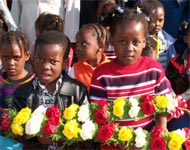
The child-to-child sanitation clubs use a peer education model in which older youth between the ages of 17 and 24 are trained as facilitators to spread messages about the importance of sanitation and hygiene to schoolchildren through various interactive strategies. These peer educators encourage the formation of child-to-child sanitation clubs and, to date, clubs are operating in over 15 schools, involving about 18,000 students. These clubs are involved in advocating for healthy schools and good hygiene practices, and warning about the dangers of unhygienic environments through participatory methods like song, dance, theatre, and games. For example, children advocated for central refuse collection spots so that they no longer had to share their play spaces with garbage. They also raised awareness on how proper disposal of syringes and other medical material could help prevent the spread of HIV/AIDS.
In addition to raising awareness around sanitation, the clubs aim to provide students with safe after-school activities, as well as leadership skills, and an opportunity to engage in arts and creative media. The project also includes a child-to-child radio programme that uses child presenters and supports the objectives of the sanitation clubs.
Organisers say that the sanitation clubs are having an impact on adults in the community as well; this outcome emerges from efforts to establish linkages between school councils and communities to ensure that hygiene education skills acquired in school can influence behaviour change at the community level. Children bring home the messages of good sanitation and begin to practice these habits at home. As a result, parents and adults have begun putting pressure on the local authorities to provide better sanitation and hygiene education and services in all schools. According to organisers, the success of the initial project has prompted inter-school discussions among teachers about the issues, and has inspired other municipalities to begin fundraising to initiate the project in their schools.
Health, Children, Youth, Sanitation.
In 2000, a UNICEF study found that 80% of all primary schools in Beira had no toilets for boys or girls and no hand-washing facilities. Few schools promoted hygiene, and those that did focused on lectures by teachers with no student participation. UNICEF states that an unexpected benefit of the project is that it is allowing girls to stay in school longer. Previously, many girls would leave school because the lack of toilet facilities for girls left them without any privacy. According to the organisers, now that child-friendly, separate sanitation facilities for girls and boys have been installed, girls are staying on to complete their basic primary education.
UNICEF is working closely with the Ministry of Education to see how the sanitation clubs can be replicated in other communities. As part of its national curriculum reform, Mozambique has committed 20% of the school term to reflect local issues. UNICEF is pressing for hygiene promotion activities to be part of that 20%.
In 2009, UNICEF introduced Community-Led Total Sanitation (CLTS) in programme schools in an effort to accelerate construction of new facilities with support from parents and schools themselves and adequate use of the facilities already available in the schools. (Click here to learn more about the CLTS approach.) This process involved training of 82 people from 20 districts in May 2009. UNICEF was then invited to attend the National Meeting of the Ministry of Education and Culture (MEC) to present the new approach to more than 50 Education Officers coming from all provinces of the country. This meeting was chaired by the Vice Minister MEC who appreciated the new approach and asked the education colleagues to support this approach to accelerate sanitation and stop open defaecation in schools and surrounding communities. The CLTS implementation strategy was then presented and a joint planning exercise undertaken between district governments and non-governmental organisations (NGOs) at a training held in Manica in June 2009.
UNICEF Mozambique website on July 3 2008 and December 2 2009; and WASH in Schools Programme Brief 2009, sent from Thierry Delvigne-Jean to The Communication Initiative on February 2 2010.
- Log in to post comments