










































CR: A User's Guide to the Technology
"As hands-on participatory community development specialists it is in your interest to be aware of the different options open to you in sourcing, maintenance and operation of the equipment that is most suited to your individual needs." - Jocelyne Josiah, UNESCO New Delhi
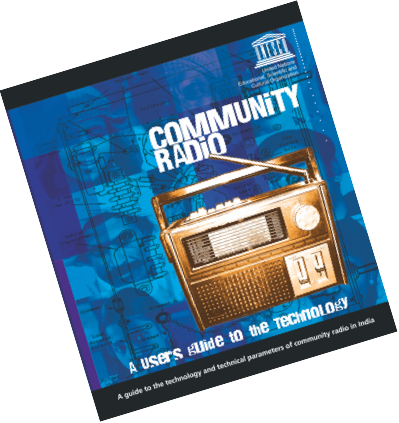
This guide to technical parameters of community radio (CR) in India was produced for potential community radio operators, taking into account the Government of India's allowing community radio stations (CRS) in India in late 2006 and their intention to establish a large number of CRS all over the country. "It is all too easy to forget about the technology while we exult in the joy of hearing our own voices and our ideas over a speaker or radio set; but it is important to realize that the technology of radio is what allows us to preserve these thoughts and send them out to our listeners."
The outcome of many years of practical field work, this publication contains the inputs of a number of communication and audio/video professionals. Conceptualised and written by Ideosync Media Combine, a communication for development organisation based in the National Capital Region (NCR) of Delhi, India, and published by the United Nations Educational, Scientific and Cultural Organization (UNESCO), it explores the technology used within CRS and the process of decision making that goes into the selection, installation, and maintenance of various pieces of equipment. For those who are technically more adventurous, detailed notes on equipment are also provided.
In a nutshell, what this manual hopes to present is:
- A user-level understanding of how to set up and equip a CRS and a taste of the kind of decisions you will have to make while planning your CR setup;
- An understanding of the types of equipment that a CRS requires, their functions, and the costs involved;
- An understanding of how the various components of a radio production and the broadcast process work together;
- An understanding of CR-related regulations, technical parameters, and the licensing procedures applicable in India; and
- Enough insight into the "tech stuff" to inspire you to learn more about the electronics and physics of it.
Readers will also find the information on the different options open to community development specialists in sourcing, maintenance, and operation of the equipment that is most suited to their individual needs. The knowledge levels of the end user were taken into consideration, as evidenced by the comments, detailed notes on equipment, diagrams, illustrations/photographs, cross-references, and a list of organisations that can further assist in technical and social aspects of CR. The appendices also include suggested equipment setups on which you can base your own assessment of the equipment combinations you require.
285
Email from N. Ramakrishnan to The Communication Initiative on August 18 2016; and UNESCO website, August 18 2016. Image credit: © UNESCO
- Log in to post comments