










































Demand Creation for COVID-19 Vaccination: Overcoming Vaccine Hesitancy through Social Marketing
The George Washington University (Evans); Strategic Social Marketing Ltd. (French)
"A brand's strength is generating 'demand' for behavior change, making it desirable for the specific population to want to change, such as to move from being hesitant toward vaccination to getting the COVID-19 jab."
In the early phases of COVID-19 vaccination (2021-2022), many countries around the world have more vaccine demand than supply. However, hesitancy will increasingly be a key factor to be overcome in achieving global population protection. This paper reviews theory, evidence, and practice recommendations from the fields of health communication, health promotion, health education, behavioural economics, and social marketing to develop a vaccine demand creation strategy. Following on an earlier paper by the same authors (at Related Summaries, below), the paper proposes evidence-based actions that governments, public health agencies, and community-based organisations can take to create demand based on an analysis of the degree and basis of vaccine hesitancy in specific population groups (segmentation). It presents a prototype COVID-19 brand identity based on the reality that there are multiple vaccine brands in the market and a need for specific marketing to build confidence and demand for them - both collectively and for individual vaccines.
The analysis is grounded in diffusion of innovation (DOI) theory, whereby the authors envision a diffusion curve ranging from the early adopters, who actively seek vaccination, to those who are unsure or hesitant, to those who actively resist and or are actively opposed to vaccination. In the short term, COVID-19 demand creation will be relatively easy, as the early adopters will come forward without much persuasive effort. However, as time goes on and as the hesitant come to the front of the queue, there will be a need for more targeted approaches that speak to the concerns held by these groups. These approaches should reflect the fact that choosing one product, service, or health behaviour over another involves comparisons of costs and benefits and the overcoming of barriers associated with the product, service or behaviour. For COVID-19 vaccination, this will involve where a population stands on the diffusion curve for vaccine uptake - from enthusiastic to resistant.
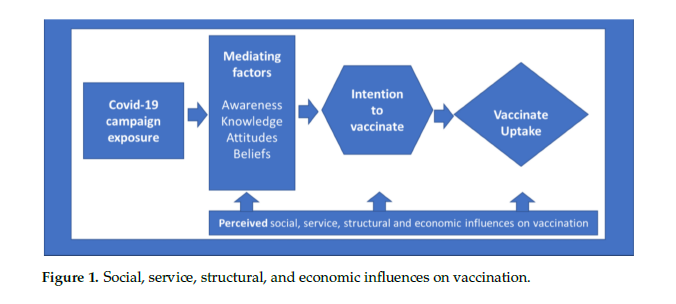
The model presented in the paper is also based on prior vaccination research efforts that understand vaccine uptake as being mediated by changes in vaccine beliefs and intentions delivered through COVID-19 promotional campaign exposures (e.g., consumption of advertisements and other content on media, including social media). This process of demand creation through promotional efforts occurs in the context of social support from government and civil society, service and product availability, healthcare system structures, and economic factors that may promote or inhibit vaccine uptake. (See the figure above) Overcoming hesitancy requires acknowledging that demand creation occurs within these marketplace system dynamics and accounting for them in branded vaccination campaigns.
Figure 2 in the paper illustrates a model of vaccine choice architecture that could be used to inform the development of a vaccination promotion brand strategy. Also outlined (in figure 3) are four main types of competition with vaccine promotion that the authors suggest must be addressed in developing a generic vaccine promotion brand at any stage of product roll out:
- Simple indifference, lack of concern, and inertia as barriers to action (in response to which one might remind citizens of the risks associated with not being vaccinated);
- Misinformation, such as mistaken comments (especially problematic when made by from highly visible public officials or celebrities) about vaccine efficacy, effectiveness, or side effects, etc.;
- Disinformation, such as anti-vaccine advocacy and active promotion of known false narratives in order to create a negative public opinion and build hesitancy and resistance to vaccination; and
- Vaccine rivalry and nationalism drivers between competing vaccine producers located in different countries.
As suggested here, most strategies will employ a mix of the following intervention types and forms, which are based in behavioural science research and insight:
- Hug - an active, positive exchange involving incentives to reward people who choose to do a particular behaviour (e.g., access to a shopping mall if you have a vaccine certificate).
- Smack - an active, negative exchange that uses disincentive punishment for conscious/considered behaviours (e.g., not being allowed into a shopping mall without proof of vaccination).
- Shove - a passive, negative exchange that involves a disincentive punishment on the automatic/unconscious decision (e.g., the inconvenience required to take multiple antibody tests before being able to work if you are not vaccinated).
- Nudge - a passive, positive exchange that involves incentives to reward people who do a particular behaviour (e.g., a default scheme for the whole population calling people to be vaccinated).
In integrating these concepts into vaccine promotion branding, co-design with citizens' input is necessary to understand audience barriers and potential supports for demand creation. For example, rounds of focus groups, semi-structured interviews, and population-level attitude, awareness/belief, and reported behaviour might be conducted. Based on this formative research, a demand generation programme plan is developed that includes: a detailed strategic and operational plan showing all steps, behavioural strategies, message strategies and channels, priority audiences, a theory of change model, a stakeholder management plan, a monitoring and evaluation plan, methods and measurement tools, and a media communication plan.
According to the authors, the demand generation plan should be implemented in partnership with a local media organisation, and all materials and interventions, including graphics, text, educational, and video content, are to be pre-tested with community members before deployment. The plan should include:
- Efforts to raise public awareness of COVID-19 vaccination - e.g., through social media, radio, TV, online, and print advertising (billboards and posters);
- Pre-vaccination and point of decision promotion (including promoting vaccination as a social norm and using the tactics defined above) in healthcare facilities through informational didactic videos, posters, and pamphlets, as well as a website, that explain the benefits and safety of, and dispel myths about, the COVID-19 vaccine;
- COVID-19 vaccination ambassadors and partners, including influential persons, organisations, businesses in local communities who will be recruited and trained to deliver pro-vaccination information within their towns and villages and to provide continuous feedback about the programme;
- Educational-entertainment (edutainment) in the form of a reality-based video and radio series that depicts a family and community with vaccination-age children making decisions to get vaccinated, to be delivered on TV, radio, and social media; and
- A service design strategy that ensures that access to vaccination is an easy, low-cost experience that instils confidence - in part by engaging citizens to call people for vaccination, to administer vaccines, and to follow up with vaccine recipients.
The authors stress that branding of vaccination behaviour and specific COVID-19 vaccine brands will "be crucial to overcoming hesitancy....To create effective brands, we need to bring them to life using a full range of intervention strategies including creating messages framed through personas (characteristics of trusted individuals for the hesitant audiences) and creating choice architectures (i.e., frameworks of choice in the real world in which choosing to be vaccinated for COVID-19, and trusting in a specific vaccine brand) that are favorable to increasing vaccination rates (i.e., making the right choice)."
In conclusion, there is a need for well-researched and tested demand creation strategies that integrate with brand strategy, supply side, and service delivery. To that end, this paper has outlined: a set of theory-based strategies to develop a marketing strategy and a COVID-19 vaccination brand; a competition strategy that includes reward and incentive structures; and a specific approach to addressing hesitancy within a structured campaign format.
Vaccines 2021, 9(4), 319; https://doi.org/10.3390/vaccines9040319.
- Log in to post comments