










































Effectiveness of Participatory Women's Groups Scaled Up by the Public Health System to Improve Birth Outcomes in Jharkhand, Eastern India: A Pragmatic Cluster Non-Randomised Controlled Trial
Ekjut (Nair, Tripathy, Gope, Sh Rath, Pradhan, Su Rath, Kumar, Nath, Basu, Ojha); University College London (Copas, Haghparast-Bidgoli, Prost); University Medical Centre Rotterdam (Houweling); Jharkhand State Health Mission (Minz, Baskey, Ahmed); Development Solutions (Chakravarthy, Mahanta)
"Participatory women's groups scaled up by the Indian public health system reduced neonatal mortality equitably in a largely rural state and were highly cost-effective, warranting scale-up in other high-mortality rural settings."
The World Health Organization (WHO) recommends community mobilisation with women's groups practising participatory learning and action (PLA) to improve neonatal survival in high-mortality settings. Accelerated action to improve birth outcomes is needed in India, where 11% of all maternal deaths and 21% of neonatal deaths happen every year. This paper reports the results of a pragmatic cluster non-randomised controlled trial testing the effectiveness of participatory women's groups facilitated by government-incentivised frontline workers called Accredited Social Health Activists (ASHAs) and their supervisors on birth outcomes at scale in Jharkhand, eastern India.
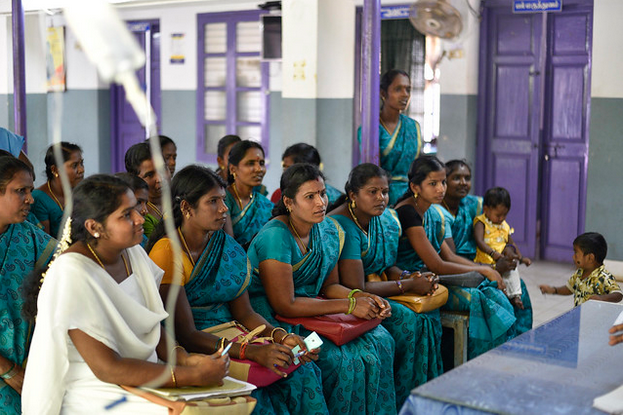
The intervention was a cycle of monthly women's group meetings, which were led by ASHAs and their supervisors (ASHA facilitators), usually held outdoors. ASHAs and ASHA facilitators were from the communities they served, ASHAs strived to include the most concerned and at risk (pregnant women and those from underserved communities), and participation in PLA meetings did not require being literate or contributing money. The PLA meeting cycle, guided by a PLA Module for the ASHA Facilitator/ASHA [PDF], had 4 phases:
- ASHA facilitators and ASHAs encouraged groups to identify and prioritise maternal and newborn health problems using picture cards and voting.
- ASHA facilitators and ASHAs created stories featuring the causes of problems prioritised by the group and potential solutions. Groups discussed these stories and solutions, identified and prioritised locally feasible strategies to implement solutions in their communities, and organised a larger meeting in which they shared their prioritised problems with the wider community and sought support for the implementation of strategies.
- Groups implemented their strategies and discussed other practical actions to improve maternal and newborn health (e.g., preparing for emergencies during pregnancy). Meetings in the third phase were topic-based (the 2-year evaluation period overlapped broadly with meetings focused on perinatal health, maternal nutrition, and childhood illnesses) and used stories and games to enable dialogue about problems and solutions.
- Groups evaluated the meeting cycle.
Partners in the evaluation - the National Health Mission of Jharkhand, the civil society organisation Ekjut, and University College London - used a non-randomised design because randomly allocating large geographical areas to ASHA training was not feasible. They purposively selected 6 of Jharkhand's 24 districts for the evaluation and purposively allocated 3 to early intervention (May 2017) and the other 3 to delayed intervention (May 2019). In 2017, Ekjut trained 645 master trainers, including state-, district-, and block-level training team members. The training cascaded down from state to block levels until it reached ASHA facilitators. To support PLA, 1,851 ASHA facilitators received 3 rounds of 5-day trainings. An ASHA facilitator led around 10 meetings per month and provided on-the-job training to all ASHAs in her catchment area over 2 months.
The trial's primary outcome was neonatal mortality. The researchers repeated the analysis for the primary outcome for the most deprived, defined as mothers belonging to the two economically poorest quintiles and who could not read or only with difficulty. Outcomes were measured using a questionnaire survey during baseline (March 1 2017 - August 31 2017) and evaluation periods (September 1 2017 - August 31 2019), administered through a prospective, community-based surveillance system described in the article.
Among the interviews conducted for 48,589 deliveries, at baseline, neonatal mortality rates (NMR) were 36.9 per 1,000 livebirths in the early arm and 39.2 in the delayed arm. Over 24 months of intervention, the NMR was 29.1 in the early arm and 39.2 in the delayed arm, corresponding to a 24% reduction in neonatal mortality (adjusted OR (AOR) 0.76, 95% confidence interval (CI) 0.59 to 0.98), including 26% among the most deprived (AOR 0.74, 95% CI 0.57 to 0.95). Twenty of Jharkhand's 24 districts achieved adequate meeting coverage and quality. In these 20 districts, the intervention saved an estimated 11,803 newborn lives over 42 months and cost 41 international dollars per life year saved.
Table 4 in the paper describes preventive and care-seeking practices for mothers and newborn infants. Effects were consistently in the hypothesised direction across all models for 10 of 16 secondary outcomes.
In terms of the most plausible mechanisms for neonatal mortality reduction in this study, the researchers suggest that strategies used by the women's groups were informed by local contexts and assets. Early infant wiping and exclusive breastfeeding were largely under the control of women and their families and appear to have increased due to the intervention. Increases in preventive practices may have played a role in helping small infants in a context where over two-thirds of neonatal deaths are linked to prematurity and low birth weight. Group members may also have capitalised on the presence of ASHAs to help them access antenatal care (ANC).
Process evaluation interviews with functionaries of the National Health Mission, Jharkhand, as well as 12 ASHAs and ASHA facilitators, highlighted several systems-level enablers for scale-up:
- Government buy-in, driven by a view that participatory meetings with women's groups were an opportunity to build the capacities of frontline community health workers and support multiple health programmes at once;
- Health systems innovations, including the rationalisation of ASHA facilitators' catchment areas and workload, and the development of an on-the-job training system; and
- An enhanced role for ASHA facilitators, who convened an estimated 60% of all group meetings.
Key systems-level barriers to scale-up included:
- ASHA vacancies due to dropouts and replacements;
- Delays in printing training modules;
- ASHAs being involved in multiple tasks, some of them unplanned engagements given at short notice (e.g., immunisation drives);
- Lack of support from ASHAs' family members; and
- Distance between meeting locations.
Despite these barriers, both ASHA facilitators and ASHAs said they were motivated by incentives for the meetings, the satisfaction of being useful to the community and respected, and the acquisition of new skills and knowledge.
In conclusion: "As neonatal survival improves, community mobilisation interventions with groups will have more limited impact on mortality and should shift their focus towards improving linkages between communities and health facilities, strengthening accountability for quality facility-based care, and tackling other health and well-being issues relevant to group members....Groups are not simply a 'platform' to deliver health messages; when engaged using dialogue-based, participatory methods, they can be an engine to support community engagement for universal health coverage..."
BMJ Global Health 2021;6:e005066. doi:10.1136/bmjgh-2021-005066 - sourced from email from Audrey Prost to The Communication Initiative on March 3 2022. Image credit: Burhaan Kinu via Public Services International on Flickr (CC BY-NC 2.0)
- Log in to post comments