










































Engaging School Communities with Health Research and Science in Kilifi District, Kenya
The schools engagement initiative was conducted through a participatory action research approach in order to maximise stakeholder buy-in, sustainability, and potential effectiveness. Three district secondary schools were selected for pilot intervention. The first step was to collect qualitative and quantitative baseline data, which could be compared with post intervention data. Attitudes towards science and health research were explored through a survey of 178 students and informal discussions with 22 local scientists form KEMRI, 3 FGDs with teachers from secondary school science departments, and 6 FGDs with students from each school.
In all discussions open-ended questions were asked about participants views on: science; school science; careers in science; health research; and ideas for the KEMRI schools engagement programme. During the FGDs with students, participants were asked in pairs or groups of three to discuss what a scientist looks like and then to draw a picture of a scientist. The students were then asked to describe scientists in relation to their drawings. These drawings showed a range of perspectives on scientists, from historical figures like Newton to doctors, nurses, and engineers. Most students were of the opinion that scientists worked hard and had a good standard of living, however, some felt that despite this, contemporary scientists never quite reach the standard of historical scientists like Newton and Einstein. A rapid analysis and summary of the qualitative data was done for the purpose of giving feedback to teachers and scientists during the participatory planning meeting.
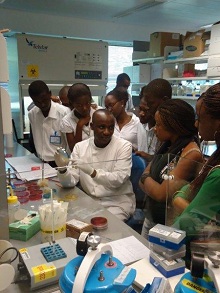
A participatory planning workshop was held with science teachers and scientists from the three pilot schools, KEMRI scientists, and representatives from the Department of Education (DEO). The workshop was designed to familiarise teachers with the work of KEMRI and health research; to give feedback to teachers and scientists on the baseline data; and to brainstorm, select, and plan activities which would promote positive attitudes towards science and health research for the second term of the 2009 school year. The workshop resulted in a list of ideas agreed upon by the group. These included:
- school visits to KEMRI during which students will be asked to prepare presentations to their fellow pupils in competitions;
- an inter-schools science/research presentation competition;
- scientists visits to schools to give motivational and scientific talks;
- a short attachment for the highest achieving student before university;
- development of educational videos;
- teacher/student/school motivation via trophies and prizes for competitions; and
- access to journal subscriptions and support with information technology [IT] and textbooks;
Following implementation of these activities, a post intervention survey, interviews and FGDs with students, teachers, and other stakeholders were conducted to asses the impact.
The pilot phase will form the foundation for a longer-term partnership between the programme and schools in Kilifi and in other districts of Kenya with the objective of continuing to promote and assess the role of schools in community engagement in science in Africa. Effectiveness of the process and activities will be evaluated through pre- and post-interventions surveys, focus group discussions, in-depth interviews, and analysis of meeting minutes.
For more information, contact:
Alun Davies
Adavies@kilifi.kemri-wellcome.org
Science Education
The baseline study showed that students reported very positive attitudes towards KEMRI's work, as well as an understanding that health research benefits many people in the future. Despite this, many students were unsure or had misconceptions around the role of KEMRI. During focus groups with students, barriers to pursuing careers in science and generally succeeding in science included high university tuition; discouraging attitudes from students, peers, and community; limited resources for teaching science and large class sizes; and that students had poor knowledge of career options. Students also related negative aspects of science to poor teaching or learning experiences. Teachers, during the planning workshop, conceded that student-led learning or learning through investigation rarely took place, in part due to limited resources and oversized classes. Students and scientists reported enjoying school science lessons when concepts were related to everyday experiences and when teachers used simple and encouraging language.
Comparison between pre and post intervention survey data revealed statistically significant: improvements in knowledge of KEMRI; more positive attitudes towards KEMRI; and more positive attitudes towards school biology. According to KEMRI, this pilot study highlights the potential research institutes have of contributing to school students’ experiences and attitudes towards science and health research. Qualitative data from FGDs and interviews supported these findings.
The Kenya Medical Research Institute (KEMRI) and Wellcome Trust.
Email from Siân Aggett on February 19, 2010.
- Log in to post comments