










































The Final Push for Polio Eradication?
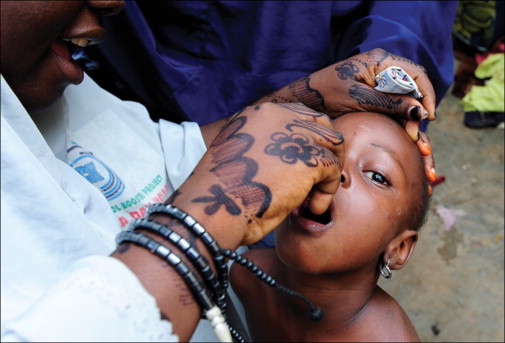
This Lancet article examines the work of the Global Polio Eradication Initiative (GPEI), which aims to stop the transmission of wild poliovirus by the end of 2013. This goal "seems tantalisingly achievable....But look a little deeper and the cracks start to appear. The three remaining polio-endemic countries have had 95 cases between them this year - Nigeria has had 57, Pakistan 23, and Afghanistan 15. And intensified efforts of late in these three endemic countries have failed to make the substantial impacts on disease prevalence seen in other countries." One aspect of the challenges involves addressing rumours, which implies the need for a communication-based approach.
The article weaves in the voice of Bruce Aylward, head of the GPEI, who reflects upon - amongst other things - a report from the Independent Monitoring Board (IMB) entitled "Every Missed Child" [see Related Summaries, below]. The report estimates the number of children in the 6 persistently affected countries who have never received even a single dose of polio vaccine to be 2.7 million. Zulfiqar Bhutta, Chair of the Division of Women and Child Health, Aga Khan University, Pakistan, is quoted here as pointing to the decreasing incidence of polio in Pakistan, which has turned polio immunisation into a bargaining chip for the Taliban. (A faction of the Pakistan Taliban has recently publicly boycotted polio immunisation campaigns in Waziristan in the Federally Administered Tribal Areas (FATA), blocking vaccine to as many as 200,000 children.) In that context, Aylward unpacks the problem into two main areas: (i) make sure that commanders are aware of the consequences of preventing children from being vaccinated; (ii) effectively communicate that polio eradication is truly a global effort, endorsed by the United Nations Children's Fund (UNICEF) and other international groups, and with broad-based financial support from foundations such as Rotary International and many governments, so not just a western programme.
As reported here, this boycott comes on the back of a building mistrust of immunisation programmes. In the months leading up to the killing of Osama bin Laden in May 2011, the Central Intelligence Agency (CIA) employed a local doctor to run a fake hepatitis-vaccination campaign around Abbottabad, where bin Laden had been hiding. The idea was to obtain DNA samples from his family members to confirm his presence there. In Bhutta's words, "[a]s a result, the community perception of immunisation campaigns being benign and benevolent has evaporated". Research led by Heidi Larson at the London School of Hygiene and Tropical Medicine, United Kingdom (UK), also suggests that dips in vaccine acceptance started after news of the CIA's bogus immunisation campaign broke. She explains: "We worked very hard to dispel rumours such as those that were circulating in northern Nigeria a decade ago due to the mistrust of western government's motives. And now, after the recent news, it will be much more difficult to give the polio vaccination programme the credibility to argue against these misconceptions."
Furthermore, Bhutta says that in some areas of Pakistan and Afghanistan, polio teams cannot get access to some areas. And in others, they might be allowed access, but a proportion of families refuse vaccination. "People say you may be right about what you're saying, but I don't want my kid to be part of this."
Both Larson and Bhutta stress the need for local, area-specific solutions to increase vaccine uptake, because reasons for vaccine refusal will vary from place to place, ranging from vaccine side-effects to religious reasons. "The programme, then, will need people with intimate knowledge of local sensitivities in each of the remaining pockets of polio if they are to produce such tailor-made strategies."
Sigrun Mogedal, a member of the IMB and an author of the report referenced above ("Every Missed Child") is quoted here as saying: "The kind of leadership we're calling for is the leadership needed to get the right information, leadership around getting access, leadership around partnering with other services, and leadership in terms of quality. We need a kind of leadership from all involved to get that whole impressive polio immunisation machinery to focus on where we haven't managed to reach children with automatic repetition of immunisation programmes. We are so close to finishing, it's doable, and we believe it is possible - even after seeing all these hurdles."
The Lancet, Volume 380, Issue 9840, pages 460-462 - sourced from: Kaiser Daily Global Health Policy Report.
- Log in to post comments