










































Girl Rising
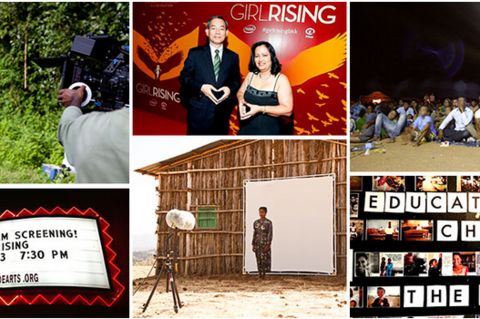
"To me the common thread for the girls in the film, was that they each believed (against all evidence) that they deserved more. They just had a deep sense of their own power and potential. For many of the girls we profiled, they often found an expression for their hope and will in some kind of art - poetry, dance, art, song." - Girl Rising Director Richard Robbins
Launched in January 2010, Girl Rising is a global social action campaign for girls' education and empowerment using the power of storytelling in an effort to change the way the world sees and values girls. It revolves primarily around a 2013 feature film, Girl Rising, and offers immediate and tangible ways for people to take action to get girls into the classroom worldwide. The purpose is to make sure people everywhere are talking about girls' education and that they understand its transformative power, recognise the barriers, and choose to get involved in order to make a difference.
Girl Rising drives change by: providing "a unique and compelling film, additional media content and a variety of tools, including discussion guides and curricula that people can watch, share and use"; using the internet and social media - as well as in-person film screening events - to connect and amplify what others who share the mission are doing around the world.
The documentary (1 hr 41 mins) tells the stories of 9 girls from 9 countries: (Sierra Leone, Haiti, Ethiopia, Afghanistan, Peru, Egypt, Nepal, India, and Cambodia). Each girl had her story written by a writer from her country and voiced by "renowned actors". Their stories reflect their struggles to overcome societal or cultural barriers. The film has been translated into 30 languages and dubbed in Hausa, Lingala, Swahili, and Congolese French versions for Nigerian and the Democratic Republic of the Congo (DRC) audiences. "Anyone anywhere in the world can see the film. You can bring Girl Rising to a movie theater in San Francisco, an office party in Mumbai or a school in Bogota. Screen it in your town!"
People are encouraged to make the screening an event - host a reception after the film, plan a discussion, or sell tickets and donate to Girl Rising or girls' education causes. To facilitate this, the Girl Rising website offers a step-by-step guide to hosting a public screening of Girl Rising, which features inspiring videos, discussion guides, a social media guide, posters, and more, as well as a corporate screening guide including a suite of tools and resources: customisable save the dates and invitations, discussion guides, and more. An educator's DVD is also available - for more information on how Girl Rising can be used in the classroom, click here. There is also a Girl Rising Curriculum, which the Pearson Foundation created to help teachers learn about the girls' education movement and effectively share the information with their students. Guided by themes covered in Girl Rising, the curriculum uses essential questions designed to stimulate critical thinking in students about political, cultural, historical, and geographic issues tied to educating girls - and about their role as global citizens and their responsibilities to their own communities. Linked to the United States (US) Common Core State Standards, the curriculum is includes an assessment tool to measure student learning and offers resources to further learning, spark discussion, and support students motivated to take action.
Together with non-governmental organisation (NGO) partners, Girl Rising launches film-based campaigns to bring visibility to the issues girls face and inspire people to dismantle the barriers that hold them back. For example:
- In India, organisers premiered the Hindi language version of Girl Rising on Star TV, a network with more than 450 million viewers in India and a reach to 100+ countries. Some of India's well-known celebrities - Priyanka Chopra, Kareena Kapoor, Amitabh Bachchan, and Freida Pinto to name just a few - stand at the centre of the India campaign. Organisers are partnering with the Indian government to create and distribute ad campaigns on the rights of girls across the country. Funded by the United States Agency for International Development (USAID), the campaign is working with Save the Children to run community programmes in Bihar and Rajasthan to drive targeted behaviour change.
- In Nigeria, organisers created a localised Hausa-version of Girl Rising with original stories from northern Nigeria. The videos are being used in communities in Kano State to build awareness and spark community-led solutions to increase access to education for women and girls. The materials have been approved by the State education authority and will be integrated into Girl Risings partner's digital libraries in 500 schools. The videos have enhanced subtitles - a feature organisers believe to be a powerful literacy tool. In mid-2016, the videos will be broadcast as a series on television.
- In DRC, the French, Lingala, and Swahili versions of Girl Rising will premiere on television in mid-2016 and will feature the endorsement of a select group of Girl Rising Ambassadors, including the Minister of Education and leading DRC musicians. (Girl Rising's Ambassador Program brings together passionate individuals from around the globe who want to play a role in their communities for the global movement for girls' education. These select group of grassroots local leaders use Girl Rising tools to rally people and organisations, raise awareness and funds, host events, and find innovative and creative ways to create lasting change for girls.) In partnership with several NGOs, organisers are reaching girls and boys in school youth clubs, creating original community theatre pieces, and incorporating Girl Rising tools into rural teacher training programmes. A special radio magazine is in production that will be distributed to community radio stations throughout the country.
- In the US, organisers partnered with First Lady Michelle Obama to launch the celebrity-backed #62MillionGirls social media campaign, earning over 1 billion potential impressions in 3 days. Girls Rising is also piloting a schools programme, integrating its common-core curriculum into classrooms.
Girls, Education, Rights
Girl Rising was founded by a group of journalists looking to answer the question of "How do you effectively end global poverty?" Their mission is based on the belief that educating girls in the developing world can transform families, communities, and entire countries - and break the cycle of poverty. Some fact about girls' education:
- 31 million girls of primary school age are out of school around the world, and women make up nearly two-thirds of the world's illiterate adults (UNESCO, 2013).
- In total around the world, 62 million girls are not in school (USAID, 2015).
- US$33 billion is India's potential economic growth if girls received the same secondary school opportunities (UNFPA, 2012).
- Each extra year of secondary school can help a girl increase their future earnings by 10-20% (USAID, 2015).
- Girls who complete secondary school are up to 6x less likely to marry as those who do not (USAID, 2015).
- Each extra year of a mother's education reduces the probability of infant mortality by 5%-10% (USAID, 2015).
- Almost a quarter of young women aged 15-24 today (116 million) in developing countries have never completed primary school and so lack skills for work (UNESCO, 2013).
Some evidence of impact as of 2016: 200 million-plus households were reached during CNN International broadcasts in 100 countries; there have been 20,100-plus educational, grassroots, and corporate screenings reaching 300,000-plus people in communities worldwide; there have been 147 high-profile screenings for policy leaders; there were 3,000-plus Girl Rising themed events in 158 countries on International Day of the Girl (marches, screenings, performances, and more); 3,800 educators from 100 countries and all 50 US states downloaded the Girl Rising Curriculum, and 1,200 Educator Edition DVDs were sold; and there are 350-plus Global Girl Rising ambassadors leading change in 60 countries.
UN Foundation, Girl Up!, Intel, HP, Brookings, CNN, STAR TV, Ford Foundation, Google, USAID, CARE, WorldVision, PLAN, Partners in Health, FHI360, Women in the World, Council on International Education Exchange, Alicia Keys, Freida Pinto, Priyanka Chopra, George Washington University, Save the Children, The White House, The Government of India, and many more.
Girl Rising website; Girl Rising Facebook page; "The Story Behind Girl Rising, the Most Powerful Film You'll See This Year", by Christine Horansky, Huffington Post, March 17 2014 - all accessed on May 20 2016; and email from the Girl Rising Team to The Communication Initiative on May 24 2016. Image credit: GIRL RISING © 2013
- Log in to post comments