











































Greater Than AIDS

Inspired by a line in a speech by US President Barack Obama on World AIDS Day in 2006, the central idea behind the Greater Than AIDS message, which is presented as an "internal dialogue" within the Black community, seeks to inspire hope and promote the possibility of change in the AIDS epidemic facing Black America through the united actions of individuals, families, and communities. "The sustained collaboration by media to deliver a concise and consistent message creates a powerful opportunity to draw attention about the disproportionate impact of HIV on Black America and promote both individual and community-level action," said Drew E. Altman, President and Chief Executive Officer (CEO), Kaiser Family Foundation (KFF).
Greater Than AIDS stresses 6 specific actions in response to the epidemic: being informed; using condoms; getting tested - and treated, as needed; speaking openly; acting with respect; and getting involved.
The campaign's logo is the mathematical symbol for "greater than." This simple image is intended to visually and readily convey unity and empowerment. The symbol also has the effect of suggesting forward action - like an arrow. The symbol is mimicked in the popular hand sign for "peace" rotated 90 degrees.
The campaign brand and initial creative elements begin rolling out during the week leading up to National HIV Testing Day (June 27) in 2009. The first wave of campaign content included radio, outdoor, print, and online elements, with television content planned for release in the fall of 2009. Test 1 Million, a corresponding campaign produced by the Black AIDS Institute to test one million Black Americans a year also is being distributed as part of with the Greater Than AIDS campaign. The multimedia Greater Than AIDS website serves as the primary referral for all campaign messages. Here, for example, one can learn about how "Open and honest conversation about AIDS saves lives. Be Greater Than AIDS, break the silence." Information about HIV/AIDS facts, how to protect oneself, where to find local testing centres, how to take action, etc. is included - using videos and other interactive technologies.
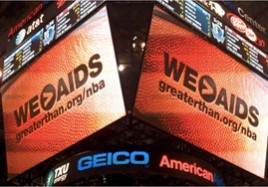
In addition to the interactive, multimedia website, examples of the campaign's presence include:
- Clear Channel Communications distributes Greater Than AIDS PSAs across its network of more than 800 radio stations serving over 100 million US listeners each week. Clear Channel is also working with the campaign to place PSAs across its more than 200,000 outdoor advertising displays in the US, with a focus on markets with the highest rates of HIV infection among African Americans.
- ESSENCE Communications contributes advertising space and online media for Greater Than AIDS PSAs. ESSENCE magazine reaches more than 8.1 million women each month, and Essence.com reaches 1 million each month.
- National Newspaper Publishers Association (NNPA), representing more than 200 Black community newspapers across the US, introduced the Greater Than AIDS campaign at its National Convention (June 26-27 2009, Minneapolis, Minnesota) and provided free onsite HIV testing as part of BAMP's Test 1 Million initiative. As part of a commitment through Act Against AIDS, the NNPA also produced a series of editorials about the impact of HIV/AIDS on Black America for its News Service. NNPA also worked with BAMP to provide complementary web-videos featuring interviews with people living with and affected by HIV/AIDS for posting to both BlackPressUSA.com and member newspaper websites, as well as to work with member newspapers to place Greater Than AIDS print and online PSAs.
HIV/AIDS.
According to campaign organisers, AIDS has from the beginning disproportionately affected Black Americans, who today account for nearly half of new HIV infections in the US, while representing just 12% of the population. Some 500,000 Black Americans are estimated to be living with HIV today - and those infected face greater barriers to care and treatment and are more likely to die of AIDS than other racial or ethnic groups. According to a recent national survey by KFF, Black Americans are more personally worried about HIV/AIDS - with more than one in three having a family member or close friend who is living with or has died from HIV/AIDS - as compared to other races or ethnicities. Even so, tracking surveys reveal a decreasing sense of urgency, including among Black Americans, about the epidemic. The same survey indicated that 44% of Black Americans name media as their primary source of information about HIV/AIDS, far more than any other single source, including family or health care providers.
The Black AIDS Institute is a founding partner, providing leadership and technical assistance. Other partners include: Act Against AIDS, a multi-year effort by the US Centers for Disease Control and Prevention (CDC). The Kaiser Family Foundation provides strategic direction and day-to-day management and oversees the production of the media campaign. Additional financial and substantive support is provided by the Ford Foundation, Elton John AIDS Foundation, and MAC AIDS.
"New Media-led Effort Responds to AIDS Crisis in Black America", June 25 2009 KFF press release; and Greater Than AIDS website, January 13 2011.

- Log in to post comments