










































Human-Centered Eradication: A Social Science Approach
Anthrologica (Jones, Bedford); United Nations Children's Fund, or UNICEF (Hickler)
This presentation explores the meaning of "human-centred" in the development context - specifically, with regard to disease eradication. It is offered in the context of increasing recognition of the importance of social and behavioural determinants in disease control and public health. The presenters ask why, despite this recognition, human-centred approaches are so challenging to put into practice. Here, they attempt to help foster understanding and integration of these approaches.
Several slides explore different figures of "the human" from different traditions:
- Anthropology and sociology - insights from these disciplines include:
- Understand local experience, meaning, and beliefs regarding disease; most human behaviour is reasonable if looked at this way.
- Listen to community perspectives before prescribing solutions.
- Involve communities in the development and implementation of solutions.
- Behavioural sciences help us understand that:
- Humans are riddled with cognitive and behavioural biases.
- Humans overestimate their ability to describe what they do.
- People easily ignore information and contradicts existing beliefs and assumptions.
- Human-centred design (HCD):
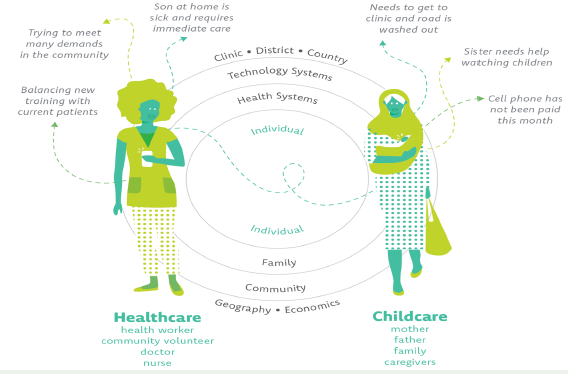
- Is problem-driven and focuses on the entirety of human and environmental factors.
- Takes insights from social and behavioural sciences and designs them into methods.
- Encourages teamwork and co-design of solutions directly with end users (e.g., involves observing and talking to people in their home, community, or clinic).
One slide includes a side-by-side comparison of the above three traditions with different comparative descriptors of how they approach their work. The presenters ask the question: Can these distinct approaches be synthesised? They go on to outline principles of such a synthesis approach, which involves 6 principles - e.g, "Knowing is not enough...Information is rarely enough to influence behavior." They also outline a 5-step process - e.g., user research that asks, "What stands in our way? Apply multi-method approaches, mixing observation with dialogue and participation." Two subsequent slides illustrate research methods: (i) observations (e.g., through peer-to-peer observation, home visits, non-participant observation, first-hand experience, and/or artifact collection) and (ii) interviews to collect what people - caregivers, health-care workers, community leaders, families, communities - think and feel, in their own words.
The presentation concludes with a series of questions for reflection and discussion, such as: "Why do global disease control initiatives so consistently fail to take human-centered approaches?"
Editor's note: The above is a summary of a presentation delivered at Shifting Norms, Changing Behaviour, Amplifying Voice: What Works? The 2018 International Social and Behavior Change Communication (SBCC) Summit featuring Entertainment Education, held April 16-20 2018 in Nusa Dua, Indonesia.
Email from Ben Hickler to The Communication Initiative on April 26 2018.
- Log in to post comments