










































The Impact of a Human Papillomavirus (HPV) Vaccination Campaign on Routine Primary Health Service Provision and Health Workers in Tanzania: A Controlled Before and After Study
London School of Hygiene and Tropical Medicine (Gallagher, Baisley, Lees, Watson-Jones); Mwanza Intervention Trials Unit, National Institute for Medical Research (Gallagher, Erio, Watson-Jones)
Resource-poor countries carry over 85% of the disease burden of cervical cancer, 70% of the cases of which can be prevented by two human papillomavirus (HPV) vaccines that have been described as widely licensed, safe, and efficacious. In 2014, the Tanzanian Ministry of Health and Social Welfare (MoHSW) began a Gavi-supported HPV vaccine demonstration project using school-based delivery in Kilimanjaro region, northern Tanzania. Yet introducing a multi-dose vaccine such as the HPV vaccine to a novel population that requires outreach activities and careful community mobilisation could potentially stress under-resourced health systems and affect the delivery of other services. Considering that Tanzania had only 43.6% of the World Health Organization (WHO)-recommended number of health workers required to deliver a health service of minimum quality, this study sought to determine the impact of the government's school-based HPV vaccine campaign on the provision of routine primary health services and staff workload.
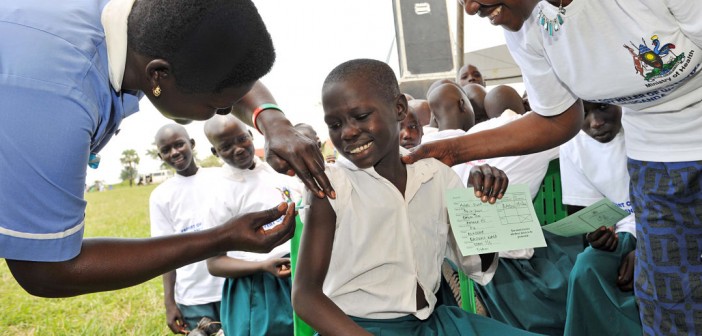
HPV vaccine was delivered in Kilimanjaro region between May 3-9 2014 (dose 1) and November 1-7 2014 (dose 2) by health facility nurses in primary schools within their facility catchment area. The vaccine was offered to all schoolgirls who were in grade 4 and who were aged 9 years or older. Out-of-school girls who were aged 9 years were informed by community mobilisation activities that they were eligible to receive the vaccine in health facilities. The school-based campaign delivery approach resulted in 2-3 health workers, half of an average facility's workforce, leaving the facility to conduct outreach in schools for 3 days, twice in the year. Health workers mitigated the impact of staff absence on the provision of routine services at the facility despite the general shortage of health workers.
Data on daily numbers of consultations were collected from health facility register books in 63 dispensaries and health centres in North-West Tanzania for 20 weeks in 2014. Changes in outpatient, antenatal care (ANC), family planning (FP), and immunisation service activity levels before, during and after the two HPV vaccination campaigns in 30 facilities in Kilimanjaro region ("intervention facilities") were compared with changes in activity levels in 33 facilities in Arusha region ("controls"). Qualitative interviews were conducted with health workers in Kilimanjaro region who delivered HPV vaccination and those who remained at the facility during in-school HPV vaccine delivery to explore perceptions of workload and capacity.
Controlling for district, facility type, catchment population, clinical staff per 1,000 catchment population, and the timing of other campaigns, no evidence of a decrease in consultations at the health facility during HPV vaccination week was found across outpatient, ANC, routine immunisation, and FP services. No key informant (KI) perceived that the HPV vaccine sensitisation activities in the community affected the uptake of other routine vaccines, or dissuaded patients from coming to the facility during the campaign week. KIs reported that the accuracy of recording data in register books did not change during the campaigns. In short, there was no clear detrimental effect of the HPV vaccination campaign on routine health service activity.
Overall, KIs were positive about the benefits of the HPV vaccine to the community and, despite the additional workload, many wanted to expand the age group in order to protect more women. Health workers involved in HPV vaccine activities supported school-based delivery, despite the transport issues and the increased workload, because they could access more girls in schools, and teachers could assist in sensitisation. They believed relying on facility-based delivery would lead to children absconding, or the distance between the facility and household being a barrier to vaccination.
However, compared to the average week before and after the campaign, health workers reported longer working hours and patient waiting times, feeling over-stretched and performing duties outside their normal roles whilst colleagues were absent from the facility conducting the HPV vaccine campaign. Mop-up activities increased the time that vaccinators spent away from the facility; up to 4 visits per school were conducted to reach girls who were initially absent from school or who refused vaccination. Vaccinators reported that sensitisation was more difficult and time-consuming for HPV vaccine compared to other vaccines because there was a low level of awareness about HPV and cervical cancer.
In conclusion, despite the human resource and health service constraints in Tanzania, at the current level of healthcare utilisation, the researchers found no evidence that the first year of this HPV vaccine school-based campaign affected the provision of consultations for routine outpatient, ANC, Expanded Programme on Immunization (EPI), and FP services during the HPV campaign week.
BMC Health Services Research (2018) 18:173. https://doi.org/10.1186/s12913-018-2976-2. Image credit: Merck Responsibilty
- Log in to post comments