










































Left Out of the Climate Communication Loop
Panos London
In this commentary, the head of the Panos London environment programme, Rod Harbinson, places the international findings and discussions surrounding the United Nations (UN) Environmental Summit 2007, in Bali, Indonesia, into a context of local climate change news in the developing world. He cites how, for example, the 2007 Intergovernmental Panel on Climate Change (IPCC) report, a culmination of the previous five year's scientific findings, states that it is people in the global South who are likely to suffer most from climate change. He juxtaposes this information with the local news situation for farmers in rural Madagascar, where people live far away from the sphere of influence of central government but want to be heard by those who make decisions and those able to offer support and agricultural knowledge.
In Madagascar, due to high illiteracy, a scarcity of electricity, and a road system in challenging condition for distribution of news, the local market plays a role in news communication. Radio stations and wind-up radios are beginning to offer a wider media landscape, though signal coverage is still piecemeal. "The founders of ‘Radio Cactus', for example, started broadcasting from the town Abovombe in 1999, with a tiny five-watt transmitter. Now they raise income from government, [non-governmental] NGOs and local businesses to operate a 500-watt transmitter with a range of 100 kilometres."
The author describes a warning from UN envoy Anwarul K. Chowdury "that the international community's development agenda would lose credibility if the people most vulnerable to the adverse effects of climate change are unable to get the information they need to add their voices to the debate." Evidence from the IPCC report, as indicated here, is not in a form that has relevance to this sector of the world population, exacerbated by the fact that only around 10 per cent of the journalists registered to attend the Bali summit event by mid-November 2007 were from developing countries other than the host country, Indonesia. "Such a discrepancy of access to the Summit between North and South is likely to lead either to lower volumes of reporting in developing countries or greater reliance on using Northern-based newswire agencies - most likely a mixture of the two. Millions in the majority world will have little chance to get trustworthy information about climate change, tailored to their context, in a language they understand, delivered by media they can access."
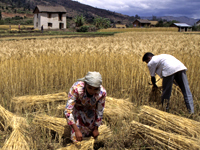
Panos London Illuminating Voices website. Photo: Madagascar: farmers harvesting, by Jean-Leo Dugast - Panos Pictures.
- Log in to post comments