










































Mobile on the Move: Opportunities in Mobile Learning from IICD's Perspective
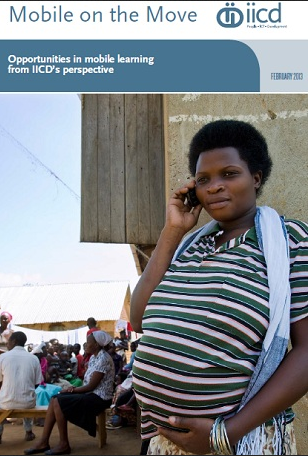
This 12-page publication shares perspectives and experiences from the International Institute for Communication and Development's (IICD) work using mobile learning to help people to better their own future. According to IICD, mobile phones and mobile learning are increasingly important for development in Africa and Latin America. Care workers, rural health facilities, and community members are using mobile services to disseminate health information. Farmers use their mobile telephone to consult with agricultural experts. In education, mobile services promote organisational and individual learning. They offer a conduit for more regular communication between parents and schools, and strengthen participation in school planning and quality improvement.
The publication explains that access to "smart" phones and mobile internet is still limited in developing countries, so most projects use text message and voice services, for people with "feature phones". Feature phones are multipurpose phones that have additional functions over basic mobile phones, but that are cheaper and less advanced than smartphones. IICD does not focus on the transfer of specific innovative technologies to developing countries. Rather, it employs participatory, multi-stakeholder approaches to seek innovative ways to use ICT to address structural problems in agriculture/economic development, education, health and water and climate.
The report outlines experiences and lessons learned in the following three categories:
M-learning in education
The report outlines several projects in which mobile phones have been used in education setting. For example, Mukuba University in Zambia uses a text messaging platform to announce changes in lesson plans, to send students their grades, and to provide updates on upcoming events. This has improved communication between the university and its students, making it faster and more effective. Chawama Youth Skills Centre in Zambia uses mobile communication to track 700 students who followed carpentry courses at their vocational training centre. The idea is to learn whether they found work in carpentry, if the skills they learned had proven useful and what aptitudes they still miss. The Centre uses this information to adapt their courses. In Uganda, educators send bulk SMS messages to teachers and community members, which deal with educative topics, announcements, and reminders of meetings. Parents in turn can text their views, for example, about teacher attendance at school, school administration, sanitation and hygiene, and the quality of teaching materials.
M-learning in economic development
In Nambia, farmers use text messaging to ask experts of the National Agricultural Information Services (NAIS) about production techniques, market opportunities, and crop diseases. The report also highlights a case study of a project supported by IICD and the SEND Foundation training 2,000 farmers in Northern Ghana to access market information. According the report, in just two years, farmers were able to increase their incomes.
Lessons learned from these experiences highlight the following:
- Combination of high-tech and low-tech - Use of high-tech ICT initiatives alongside traditional techniques, like field visits and notice boards, is a good way to disseminate market information in rural communities. Computers and mobile phones are not always reliable in remote locations, due to factors such as fickle electricity supply.
- Capacity building - Farmers benefit from training in the use of mobile services, yet this can best be offered by an organisation that they already know and trust.
- Low literacy - Most farmers trained in mobile phone usage had low literacy and therefore could not take full advantage of the training. This can be addressed by involving literate family members, relatives, and friends in training, so they can provide ongoing help and support. Fellow farmers and farmer organisations can also provide additional support.
- Sustainability - Increasing use of mobile telephones to access market information means that farmers have less need to meet people who can help them to find market information. They are taking control of their own information. This is a key step towards sustainability.
M-learning health
Using mobile telephones and a mobile application, community health workers in Mali prevent, diagnose, and treat malaria. The mobile phone application contributes to patient management by providing a format for risk assessments, strengthening case documentation of patients, and accelerating communication between health workers and clinics via text, images, and audio. The report outlines another case study in Uganda, in which Health Child Uganda sends mothers text messages with information about prenatal and postpartum care. The messages tell women how they can protect themselves and their unborn children against diseases and reminds them of the importance of going to health clinics for check-ups during pregnancy. Lessons learned highlight the following:
- Integration - Health-related text messages are best integrated into existing health sensitisation programmes that already have a basis of trust with the target group.
- Health communication expertise - Specific skills are required to design useful health messages that fit the 160-character SMS message limit.
- Involve men as well as women - Women do not always own a mobile phone, but their husbands often do. Health information for wives can be sent to husbands so that he can convey the message. So far, fathers-to-be have responded well to the text messages.
- Power of voice - To reach illiterate groups, make use of voice messages. The disadvantage is that calls are easily missed and messages cannot be stored for future reference.
International Institute for Communication and Development website on February 20 2013.
- Log in to post comments