










































Project Baduta
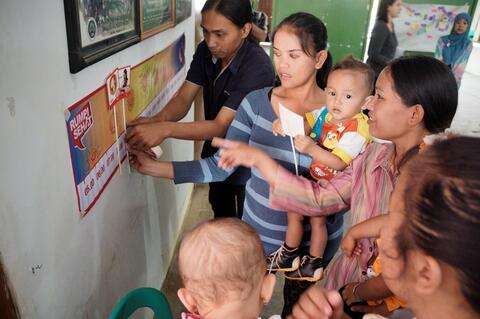
Launched in October 2013 by the Global Alliance for Improved Nutrition (GAIN), the 4-year Project Baduta focuses on: improving maternal, infant feeding, and care practices at the community level, strengthening the delivery of nutrition services through the health system, and improving access to clean drinking water. It also includes a large behaviour change component promoting appropriate feeding practices for children under two years of age and improved maternal nutrition. The 4-year programme is being implemented in 113 villages in six sub districts of Sidoarjo and Malang in East Java, Indonesia. The project aims to improve the nutritional status of children aged 6 to 24 months old and to show progress on reducing stunting of children under 2 years old by 5%.
GAIN contends that multiple channels need to be considered in the response to reduce stunting and for contributions of both the public and private sectors to be integrated. To that end, it incorporates:
- Nutritious products: improved availability and appropriate use of affordable high-quality nutritious products including fortified complementary foods and micronutrient powders through the market or through the public delivery system in accordance with Codex guidelines and the International Code of Marketing of Breast-milk Substitutes. (In some villages, doting mothers have the habit of indulging their children daily with unhealthy packaged snacks for adults; the attempt is to discourage this behavior and to present healthier, fresher alternatives for infants.)
- Health system strengthening: strengthening the delivery of nutrition services through health facilities (puskesmas) and village health posts (posyandu), particularly around maternal and child care and nutrition.
- Clean water: improved access to and demand for clean drinking water through the establishment of a sustainable supply chain of household drinking water filters and storage and community water assessment and education on appropriate household water treatment and safe storage.
A significant portion of Project Baduta emphasises behaviour change through multi-channel interventions with key messages regarding good infant feeding practices (focusing on exclusive breastfeeding, complementary feeding, and healthy snacking) and maternal nutrition, using a mix of interventions including mass media, community activation, and interpersonal communication. (Messages around hand washing with soap will also be integrated into both the community activation and interpersonal communication).
The intervention design was based on a theoretical framework developed by the London School of Hygiene & Tropical Medicine (LSHTM). It draws in part on behaviour-centred design (BCD), which is a holistic approach to changing behaviour based in evolutionary theory and commercial marketing practice. BCD employs science and creativity because behaviour only changes in response to what is new, challenging, surprising, or exciting. This idea is to tap into unconscious motives, establish new social norms, use repetition for recognition, make it compelling and aspirational, and use visual demonstration of behaviour rather than speech.
The formative research methodology relies in part on extended observation of participants - in the present study, this was conducted by video in participants' homes. This method, which involved local girls videoing caregivers in 16 households, allowed the capture of participants' observable behaviour as well as their reported actions. Findings identified the need to focus on three key behaviours and use non-conscious motives to help drive change in these behaviours. Targeted behaviours:
Related to breastfeeding: Breastfeed exclusively for 6 months; Giving formula milk will reduce your supply of breast milk; Breastfeeding saves you money; Breastfeeding is hassle-free; and Breastfeeding is enough for your baby to grow healthily.
Related to complementary feeding: It's not the size of the meal that matters, it's the content; It's important to have diverse/colourful/nutritious food; Don't feed too much rice/porridge.
Related to snacking: It's not good to feed your child snacks just before meals; Only feed your child healthy snacks; and Biscuits are not healthy snacks.
Findings on infant and young child feeding and related behavioural insights were used to structure a creative brief for development of a campaign theme, three TV commercials, and a community activation programme. A creative marketing agency translated the insights into an aspirational concept, which was pre-tested before the mass media campaign plan was finalised and community intervention begun. The overall campaign tone is that participants feel: support, empowered, and confident, that they are becoming better mothers, that they are learning and are curious to learn, that others want them to do these behaviours, that the campaign is fun and is something they want to be part of, that the programme helps them to save money and time, that they are more respected and have more value in the community as a result of their participation, and like they are part of a movement.
During the creative design process, the GAIN project design team collaborated with the academic team of the LSHTM and the design team of Playgroup, an Indonesian commercial creative agency. The academic team provided careful scrutiny of proposed storyboards and creative strategies to ensure that behaviour change principles were consistently applied and translated into creative solutions. The creative team used their extensive knowledge of the Indonesian culture and context to ensure grounding of formative research insights and behaviour change principles in a lively and socially appropriate narrative.
Implementation strategies include:
- Focus on building mothers' confidence and establishing new social norms, by using key authority figures to correct the incorrect behaviour and validate the desired behaviour.
- Present strong visual rejection of the incorrect behaviour (such as slapping away the feeding bottle) and visual demonstration of the desired behaviour (breastfeeding).
- Focus on a few clearly defined complementary feeding behaviours instead of knowledge (discourage introduction and use of infant formula; increase dietary quality and diversity of the family meal plate by reducing the proportion of rice [same foods, different portions]; and reduce unhealthy snacks before meals.).
- Address social norms and the influence of key authority figures on mothers and caregivers.
The mass media campaign theme incorporating these strategies is built around a social activity common in the communities: sharing chitchat or gossip. The main characters of the Rumpi Sehat (Healthy Gossip) campaign are (a) the "gossip lady", a silly but lovable character who always comments on the behaviour of other mothers and then slaps her own forehead when others step in to remind her that she is actually the one who has it wrong, (b) key authority figures such as grandmothers or midwives, and (c) the good mother, who is targeted by the gossip lady but actually demonstrates the good nutrition-related behaviours that need to be promoted. Examples of campaign elements:
- Arisans meetings - Arisans are an established social structure in Indonesia, with almost all women reporting to be members of such groups. The groups generally are an informal loaning system among neighbours, but this is accompanied with much socialising during meetings, and there is a high level of social pressure to always attend. The campaign builds on this familiar structure as a means of delivering some of the key activities which tap into motives of disgust, nurture, affiliation, and status. Among the arisan activities at local health centres are fun games, which are engaging and motivating mothers to participate and giving them the confidence to practice the right feeding behaviours. 'Emo demos' are designed to trigger the disgust factor - such as when dissolving packaged snack foods in water (mimicking the stomach). The aim is to lead to a radical change in practice of feeding the children healthier, freshly prepared snacks. Another emo demo compares exclusive breastfeeding (glass filled with milk) with mixed feeding (glass filled with oil and milk) to communicate that feeding infant formula reduces breast milk production.
- Street visits - Facilitators visit mothers several times throughout the campaign and use tablets as a way of engaging mothers with various elements of the campaign. During street visits, stickers are also placed outside arisan member houses and "trigger" stickers are placed on the water filter and the rice cooker to discourage mothers from bottle feeding or feeding too much rice.
- Qu'ran recital meetings - The campaign works in collaboration with religious leaders to remind mothers and fathers that Rumpi Sehat's key messages around breastfeeding and child feeding are also things taught in the Qu'ran. These meetings aim to embed these behaviours in traditional Indonesian morals and values.
- The development of three television ads in partnership with the Indonesian government, airing on national TV and encouraging more women to:
Breastfeed
Reduce unhealthy snacking
Feed their children diverse and appropriate complementary foods.
The adverts were designed so that they appear to take place in a natural village setting and tell a story rather than being about health messages. GAIN and its partners have been documenting the 'Most Significant Changes' triggered by the Rumpi Sehat campaign, which are best practice examples of women who have taken action within their communities, advocating for better nutrition. Their stories (see one example, below) have been recorded and broadcasted on local TV channels, thereby instilling a sense of pride and achievement. - Social media - e.g., Rumpi Sehat on Facebook. The campaign is also utilising Twitter to connect mothers, share success stories, and photos and make the various arisan groups feel like they are part of a bigger movement.
Infant and Maternal Nutrition
As a result of inadequate complementary feeding practices and lack of access to optimal diets, 37.2% children in Indonesia are stunted, and 37.1% pregnant women are anaemic, compromising their baby's ability to grow, learn, and develop. GAIN explains that achieving good nutrition requires an integrated approach: appropriate infant and young child feeding practices including exclusive breastfeeding for six months, continued breastfeeding for two years, and timely and appropriate complementary feeding; improved maternal nutrition; access to quality health services; water and sanitation; and other public health measures.
Organisers have also found that health professionals often lack the skills, tools, or time to provide nutritional guidance to patients and community members. On the other hand, formula manufacturers use large marketing budgets to wield undue influence, and enforcement of national regulations governing the marketing of breast milk substitutes is weak.
The intervention was designed to respond to the findings of formative research described above, including these insights:
- Knowledge about nutrition is important but insufficient to lead to change: Mothers were familiar with the key messages of "breast is best" and "diverse diet". But they did not necessarily understand or believe the information behind these slogans, nor act on it.
- Confidence is crucial: Many mothers lack confidence in their own ability to breastfeed or in the quality or quantity of their breast milk, which leads to the introduction of formula, or in their ability to make the right choices. Their uncertainty means that well-intended advice can lead to undesired behaviour such as early introduction of formula and/or complementary foods.
- Some parents act on a belief that the baby knows best: A parent's focus on nurturing their baby can turn into an effort to soothe the child rather than provide for nutritional needs. Parents often respond immediately to their children's demands by pacifying them, providing unhealthy snacks or bottled milk, even close to mealtime.
- Peer influence can have a negative influence: Family, friends, and neighbours affect child feeding behaviour, often offering morsels of food to "help" quiet the baby.
Key takeaways for nutrition social and behaviour change communication (SBCC) gleaned from the project:
- Focus on non-conscious motives for behaviour: The theoretical framework and formative research methodologies provided key insights, which also revealed some of the important non-conscious drivers of behaviour (e.g., status and affiliation).
- Focus on fewer behaviours to achieve greater impact: Formative research, together with stakeholder input, prioritised three feeding behaviours.
- Engage in effective multisectoral partnerships: Intervention design development and execution involved a diverse group of experts, including private sector creative talent, academic experts, field researchers, and government representatives.
- Capitalise on local and commercial expertise: This helped shape design principles for the TV commercials:
- "Keep it real": Use real-life dialogue, portraying everyday situations and realistic actions, and avoid using a lecturing tone or public health jargon.
- Use visual demonstration: Show both the incorrect and desired behaviours in action, followed by a reward for the correct behaviour in the form of approval by the key authority figure or a smiling baby.
- Confirm a social norm: Make the target behaviour appear common across the population.
- Ensure "stickiness" of the TV commercials and key messages: Use attention-grabbing, funny gestures or sounds that are funny or a bit cheeky.
The impact of the project, including indicators of both relevant behaviours and nutritional status (anthroprometric measures and biomarkers), will be captured in an independent impact evaluation. To date, the behaviour change communication component has reached 2.5-3 million people through TV commercials and 60,000 people through community mobilisation activities. Interpersonal communication has reached more than 10,000 mothers with children under two years and an additional 15,000 mothers of children aged two to five years.
GAIN, in partnership with Indonesia's Ministry of Health’s Directorate of Community Nutrition, Save the Children, Yayasan Paramitra, PT Holland for Water, and LSHTM.
Email from Alia Poonawala to The Communication Initiative on September 29 2017; and GAIN website; Project Baduta description on the GAIN website; Project Baduta presentation [PDF], Environmental Health Group (EHG) of the London School of Hygiene and Tropical Medicine, July 2014; Behaviour-Centred Design: BADUTA-Indonesia [PDF], Strengthening Partnerships, Results, and Innovations in Nutrition Globally project (SPRING); and SPRING website - all accessed on September 29 2017.
- Log in to post comments