










































Reflecting Strategic and Conforming Gendered Experiences of Community Health Workers Using Photovoice in Rural Wakiso District, Uganda
Makerere University College of Health Sciences (Musoke, Ssemugabo, Ndejjo, Ekirapa-Kiracho); University of the Western Cape (George)
"Given that CHWs play a significant role in primary health care..., understanding their gendered experiences is important in ensuring that health systems as a part of the social fabric of societies act as mechanisms that promote gender equality, rather than retrench gender conformity."
Gender - the social roles, activities, characteristics, and behaviours that society prescribes for men and women - affects human resources for health. This paper explores the differential roles of male and female community health workers (CHWs) in rural Wakiso district, Uganda, using photovoice, a community-based participatory research approach through which participants take the lead in the data collection (photography) activity and express their viewpoints directly.
Specifically, the purposes of photovoice include enabling people to record and reflect on their community's strengths and concerns, promoting critical dialogue and knowledge about important community issues through large and small group discussion of photographs, and enabling communities to visually communicate with policy makers. Photovoice "can support empowerment and emphasizes individual and community strengths, co-learning, community capacity building, and balancing research and action...It can enable people with limited power to capture aspects of their environment and experiences and share them with others..."
Locally referred to as village health teams (VHTs), Uganda's CHWs are the first point of contact for healthcare delivery in the community. CHWs in Uganda, the majority of whom are female, are community volunteers who can read and write (preferably in their local language). They are selected by local leaders and trained by health professionals to provide accurate health information and appropriate linkages to health services. Specifically, CHWs carry out health education, conduct household visits to promote sanitation and hygiene, mobilise the community for public health interventions such as immunisation, treat children below 5 years of age using integrated community case management of childhood illnesses (iCCM), and refer patients to health facilities.
Conducted in 2015 and 2016, the study team trained 10 CHWs (5 males and 5 females) on key concepts about gender and photovoice. During the training, every CHW was provided with a digital camera and a notebook for use during the research. The CHWs took photographs for 5 months on their gender-related roles, which were discussed in monthly meetings. (The meetings for the first 3 months were conducted separately for males and females, while those for the last 2 months were held jointly.) The discussions from the meetings were recorded, transcribed, and translated to English, and emerging data were analysed.
A total of 432 photographs were taken during the study. The results are presented in the paper, with illustrative quotations from CHWs, under 7 main themes as follows: addressing men on their terms; female-related health issues; treatment of children; response to emergencies; geographic coverage during community mobilisation; involvement in manual work; and availability to offer services in community.
In general, although responsibilities were the same for both male and female CHWs, they reported that in practice, CHWs were predominantly involved in different types of work depending on their gender. Social norms led to men being more comfortable seeking care from male CHWs and females turning to female CHWs. Due to their privileged ownership and access to motorcycles, male CHWs were noted to be able to assist patients faster with referrals to facilities during health emergencies, cover larger geographic distances during community mobilisation activities, and take up supervisory responsibilities. Due to the gendered division of labour in communities, female caregiving roles related to child care were reinforced, and also made female CHWs more available to address local problems.
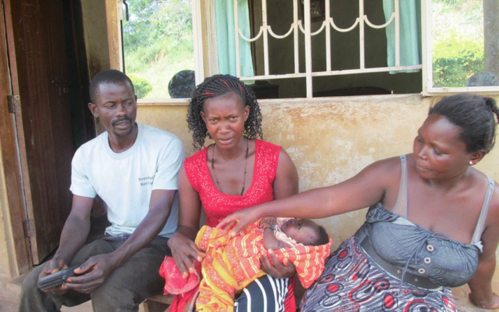
As an example of a gendered difference, experiences of female CHWs looking after their own children contributed to their comfort in supporting children and the confidence community members had in them. A 30-year-old female CHW said the following when discussing one of the images she took (see above): "In that photo, that woman had refused to take the child for immunisation. I approached her and told her to take the child to be immunised as it was being carried out by qualified health professionals. I explained to her well and she agreed to take the child for immunisation. She easily accepted what I had told her since I am a mother with children just like her."
On the other hand, the researchers note that mobilising communities for interventions such as mass immunisation, in which male CHWs are more involved due to access to resources and social norms, among other favouring factors, "is also crucial to ensure high coverage of public health initiatives. Due to gendered roles of CHWs, communities without male CHWs may face limitations in carrying out such activities unless these gendered barriers and norms against female CHWs are addressed."
In conclusion, this study has provided "insights into various aspects of the gendered experience of CHWs in rural communities in Uganda, reflecting strategic positioning, gendered access to resources, division of labour, community values, and social norms." The researchers suggest that these differing roles and viewpoints should be considered while designing and implementing CHW programmes to avoid further retrenching gender inequalities and norms. In addition, their experiences of using the photovoice methodology can inform future studies in Uganda and other parts of the world.
Human Resources for Health 16, 41 (2018) doi:10.1186/s12960-018-0306-8
- Log in to post comments