










































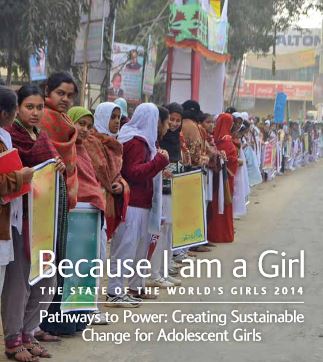
The State of the World's Girls 2014: Pathways to Power: Creating Sustainable Change for Adolescent Girls
Plan International
"The eighth report in Plan’s annual State of the World’s Girls series, Pathways to Power: Creating Sustainable Change for Adolescent Girls, asks what will shift the unequal power relations that bolster gender discrimination, injustice and inequality for girls and women in some form in every country in the world?"
This annual 'Because I am a Girl' report series, published by Plan, assesses the current state of the world's girls and, through research, interviews, and the voices of girls themselves, the report investigates the notion of power, particularly structural barriers that block young women's paths to power. "It looks at the way power operates within the social institution of families and communities (in all their diversity), and also within the more formal institutions of the state and the market place; at how the wider world is governed and at the role of the economy." It asks: "How can power be reconstructed in these spaces so that equality - and girls - can thrive?" It also looks at "collective power - and looks at the importance of girls' participation and collective action."
Chapter two examines: attitudes, expectations, and practices that reinforce discrimination; thinking that supports patriarchy, inferiority of women, and the way power is held; and how religion, culture, and the media help reproduce these ideas that lead to violence against women (VAW), unpaid care work, and child marriage.
Chapter three looks at governance, including legal and political frameworks and how they influence the lives of women and girls. It makes a case for gender-equal governance, suggesting an increase in the number of women in decision-making positions.
Chapter four looks at "girls and the formal and informal economy, and at how, in this more public world, resources are allocated and opportunities are made available." It examines links between education and employment, how more education may not match up with employment and what is being done through "skills training, activism and mentoring, to bring about change, so that ‘economic empowerment for girls’ becomes more than just words on paper."
Chapter five looks at "what girls and young women need to build effective and collective leadership" that will enable their challenges to rights violations. It suggests collective action and support for participation and leadership that is empowering girls to bring about change, including on a societal level.
Chapter six discusses the policies and practices needed for change in order to pave girls' pathways to power. It makes recommendations to power holders.
The concept of power is "unpacked" into four types of power relations: "Power over, Power within, Power with, and Power to." Empowerment, as described here, is: "The processes of change through which women expand their ability to make strategic choices about their lives and to participate on equal terms with men in bringing about desired changes in the society in which they live." Thus, the conceptual framework of girls’ empowerment used in the document is multi-dimensional and "involves changes in the social, political and economic spheres of governance. It is based upon a holistic approach whereby change is only possible through tackling three interconnected dimensions of agency, social relations, and structures."
The keys to power and rights are listed as: legislation for girls’ and women’s rights (called "fragile"); emphasis on girls’ and young women’s education and labour-force participation (called insufficient due to unpaid care work and domestic labour); and collective transformation of young women and girls, accompanied by attitudinal and behavioural change from adults.
Collective action is made possible through organisations that collectivise and work to support change for girls and women, many of which are under-funded. An example of a strategy for reaching girls with messages on rights is "'Sexto Sentido', an 'edutainment' television programme that aims both to entertain and to promote social change, [that has] challenged established attitudes - with young women centre stage both as actors and audience." FRIDA, The Young Feminist Fund, has asked what leadership looks like for young women and girls and lists:
- "Capacity to empower and act in solidarity.
- Communicate, guide and coordinate the group.
- Personal qualities: dynamic, active, empathetic.
- Commitment to defending women’s rights".
Mentoring and role modeling is cited as a means to create leaders among girls and young women. Collective action can include gender equality, but, as seen in the Arab Spring uprising, it can also fall away. Grantmaking organisations can make a difference in supporting collective action to bring about longer term change. Young women's ability to use and access social media can give power to their voices individually and collectively, though social media also give voice to harassers and opposers of progress on empowerment of girls.
Some uses of the internet to fight sexism include:
- Blank Noise Project, a community public-art project that seeks to confront street harassment of women, known as 'eve-teasing', in India.
- Fightback, a mobile telephone app, "serves as a panic button for women who are victims of violence."
- AMPLIFY encourages activism and links girls and boys from different countries through an International Youth Activist Network.
- Young Feminist Wire, a global online community platform for and by young feminists working on gender equality and women’s rights issues, launched by the Association for Women’s Rights in Development (AWID).
Other spaces include:
- RadFemHub
- Guerrilla Girls
- Feministing
- The Pursuit of Harpyness
- Gender Across Borders (GAB)
- Jezebel
- feminist.com
- UK Feminista
The recommendations and action plan include:
- "Gender equality and adolescent girls in the post-2015 agenda
- Accountability to women and girls
- Intensify efforts on gender-based violence"
Plan International website, November 25 2014. Image caption: Demonstration opposing violence against women, Bangladesh, 2013.
- Log in to post comments