










































Summary Report: Informal Experts' Meeting on Managing for and Communicating about Development Results
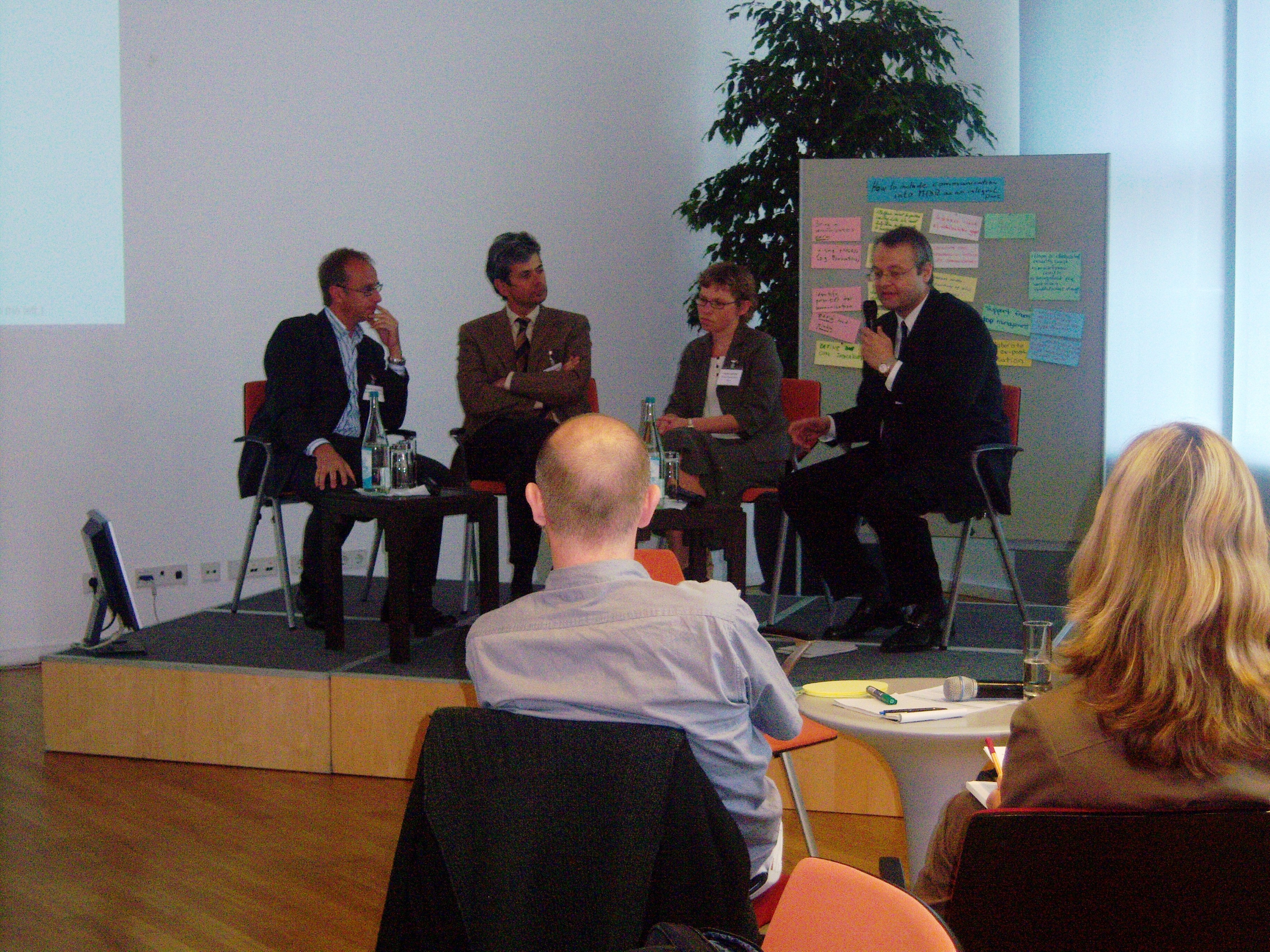
This report emerges from a 2-day May 2008 meeting that brought together staff from aid agencies responsible for communicating about the results of development aid and staff responsible for making aid policies achieve better results. Hosted by the German Federal Ministry for Economic Cooperation and Development (BMZ), the Berlin meeting was a collaboration between the Organisation for Economic Co-operation and Development (OECD) Development Centre and the German organisation AgenZ. It represented the first "official" encounter between OECD's Informal Network of DAC [Development Assistance Committee] Development Communicators (DevCom Network) and members of the DAC Joint Venture on Managing for Development Results (JV MfDR), one of the four specialised Joint Ventures of the Working Party on Aid Effectiveness of the DAC. Representatives of more than 20 bilateral and multilateral aid agencies, such as the European Commission, the United Nations Development Programme (UNDP), and the World Bank, participated in the meeting. Discussions between policymakers and development communicators constituted a first step in the development of guiding principles on the role of communication in managing for results.
Welcome and introductory speeches stressed the need for a closer cooperation between programme managers and communicators, and for improving the process of and the links between managing for and communicating about results - a subject which has become of increasing significance for all OECD member states since the endorsement of the Paris Declaration on Aid Effectiveness in 2005. Speakers also referred to the possibility of influencing the Accra Agenda for Action by raising the profile of communication.
Session I: What do we mean by development results and what information do we need?
Key Points to emerge:
- The central question is: How many people step out of poverty due to development cooperation? The current focus on inputs and outputs in managing for and communicating about results was criticised. What is needed are medium-term outcomes and long-term impacts. Outcomes and impacts take years to materialise and measure, but programme managers and communicators need to show immediate results also, as this often reflects the political expectation. The only solution: input "results" and human interest stories. And outcomes need to be linked back to results.
- MfDR and communication are directly linked; both are evidence-based.
- Objectives of programmes must be measurable. They often do not fit to communicators' needs. The communicability should always be kept in mind.
- Development results need to be related to the Millennium Development Goals (MDGs). They can work as an indicator, but it is difficult to attribute impact to specific development measures.
- Since the general public is unfamiliar with the MDGs, communicators should present development cooperation to the public as a collective effort of different donors working together with partner countries. The ownership principle needs to be promoted.
- The diversity of affected and interrelated topics (poverty, good governance, human rights, environmental issues) is another challenge to managing for and communicating about results. Therefore, communication should not only be about success stories, but also about challenges to development, in order to raise awareness about the broader development debate.
- Communication strategies have to consider national contexts.
- Communicators are clients of the MfDR process, and need to state clearly what their needs are.
- Education of programme staff is necessary to sensitise them to the issue. They also need to have the right incentives. Priorities for communication should be indentified early and jointly. This is a management decision.
- There are structural problems for multi-national and multilateral enterprise with national funds and accountability: How to communicate results globally? To whom should we attribute success? One option: Explain to taxpayers that we live in harmonised, programme-oriented, aligned world now. But the public needs to have a basic understanding of results already. News consumers are also interested in stories about multilateral institutions. For multilateral institutions, there is a need to develop a unified accountability framework that all donors can make use of - maybe the MOPAN (Multilateral Organisation Performance Assessment Network) framework?
- The audience's attention span is short, and catastrophes raise people's attention only briefly. But they can be used as entry point for further communication on development.
- There is a tendency to focus on the next problem to be solved. Positive stories focus on what has been solved already.
- Media need to simplify content and make it personal; the public cannot relate to statistics, but wants to identify with "stories". This is more difficult if the issue is too broad-based.
- Sending journalists to partner countries to cover development results is a possible option.
- It was agreed that the challenge is the embedding of a communication strategy into the management process and organisational structures from the outset. For this shift of communication, the political support of the senior management/minister is essential.
Session II: What does the Joint Venture on MfDR do, and how is it relevant for DevCom members?
Key Points: The evidence-based MfDR focuses on outcomes and impacts, and comprises practical tools. It is a management strategy that links different processes, units, and levels in government to each other. Key points to improve effectiveness include: statistics, monitoring and evaluation, planning and budgeting, and communication; they all require institutional changes and adequate incentives. The challenge is to find a comprehensive approach for donors and partners.
Session III: Breakout groups: In what ways does results based management interlink with communication?
Example 1: Agence Française de Développement (AFD), France, has established a database with 58 quantitative indicators which are included in all project preparations and sector and geographical strategies. The data of the annual reporting serve communication needs since they provide AFD concrete results and description of impact. A public awareness campaign is to be launched; the message of this campaign will be that public is asked to hold AFD accountable for its work on development. A focus on results should also be consolidated by an improved link between MfDR and communication. However, "It is self-challenging if people are asked to hold a governmental institution accountable. If one relies completely on indicators, there are no stories to tell and the 'human touch' is lost."
Example 2: The Department for International Development (DFID), United Kingdom (UK), published hometown stories with local newspapers. In one case, it told the story of a "native" who had gone to work in the field with DFID, a story which appealed to the readership and allowed integration of a discussion of development issues and DFID's role. Other examples included articles published in Bangladesh newspapers - in Bengali - and reprinted in the diaspora newspapers in the UK, and a special issue of a newspaper for kids on education and development. Short brochures "What we have already achieved in [country]" and a project with Google Earth ("Click on a spot and find information on a development project!") have been developed. The presentation revealed that a focus on key entry-points to better communication is essential: don't think of generalist, national media only. The strategy of using local and issue-specific messaging to reach wide audiences requires tailoring the message and its "packaging".
Challenges:
- Managing for and communicating about results means extra work - for both donor and partner countries.
- Donors and partners deal with different timelines and expectations.
- It remains a severe challenge to link inputs with outcomes and impacts.
- Is it possible for partner countries to have a single information system that can meet the needs of all donors?
- Communication within donor countries needs to be tailored to the level of knowledge and support of the public.
Session IV: Plenary working group: Moving forward to concrete action points.
Challenges for individual agencies: There should be a memorandum of understanding (MOU) between programme managers and communicators. Communication staff is essential to programmes, and as much a part of the process as technical experts are; therefore, they should be included in managing for results from the outset. Programme managers and communicators should appreciate each other's work. If the system is well implemented, working and serving all needs, it is an incentive itself for all involved actors.
Crucial aspects for communicating about results:
- There is a need for improved communication due to changes in the aid architecture (budget and programme support, donor harmonisation, partner country alignment and ownership, etc.).
- When talking about communication, it is crucial to distinguish between different accountability spheres (partner country/donor country) and different audiences (public or political actors in donor country/ public or political actors in partner country).
- Effective communication is about the recipient/audience. Different audiences may require different communication strategies.
- Communication is visionary and future-oriented in comparison to reporting; to clarify the difference is crucial.
Practical demands for communicating about results:
- Communicators need information about the starting point of a programme and about the actual context in which it is being implemented in order to be able to make comparisons and demonstrate the programme impact.
- Communication between donors is useful to share experiences.
- Even though communicators and MfDR policymakers may have different definitions/understanding of results because their respective needs are diverse, the key element for all should be the human development factor.
- Technical data exist which are not easy to access and to use for communication. This situation needs to be improved by collaborating more intensively with technical staff and by garnering higher management support for the communication dimension.
Challenges for the DevCom Network: There is a gap between managers and communicators because they are not used to working together. Network members would benefit from formulating their needs more precisely, which might be facilitated by collaborating more closely with experts in the field and colleagues in partner countries. In addition, more training and capacity development concerning communication are needed. The network can benefit from different perspectives within the group and should use this more efficiently, e.g. by using the network's extranet to exchange examples of how to deal with managing and communicating results in the various agencies. The questions that arise should be specified for the DevCom network and formulated in concrete terms in a future workshop.
In conclusion: "Political will and high public support are indispensible if donors really want to live up to their promises. Public support for aid is high but shallow, and people are sceptical about whether aid really works. Discussions and research in the DevCom Network show that demonstrating concrete results is the best way to convince politicians and public opinion that aid really works. In order to be able to show results, aid management needs to be focused on results. This entails, amongst other things, conceptual clarity about results, statistical capacity in partner countries, effective aid agencies and mutual accountability mechanisms. Information about results not only needs to be used in the evaluation process for more effective aid, but also needs to be available to communication departments."
DevCom News Flash - January 2009; and OECD website; and email from Steffen Beitz to The Communication Initiative on June 12 2009.

Comments

Fantastic
Very informative articles - thanks for sharing
- Log in to post comments