










































Thetha Nami [Talk to Me]
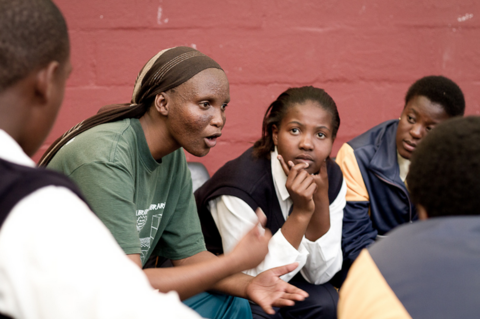
"...a youth-led intervention to organise and mobilise other young people and the wider community to challenge social norms and lack of opportunity, and access healthcare within their own locality."
Grounded in community-based participatory research (CBPR), Thetha Nami ("talk to me" in isiZulu) is a peer-led biosocial intervention for HIV prevention among adolescents and young people in KwaZulu-Natal (KZN), South Africa. Africa Health Research Institute (AHRI)'s vision is that social-justice-informed CBPR (rooted in the principles of equity, access, participation, and rights) will foster youth-led transformative action to tackle the HIV epidemic in sub-Saharan Africa.
Thetha Nami involves young people using social spaces for critical dialogue to foster solidarity and action (bonding social capital), seeking local partnerships (bridging social capital), and mobilising resources (linking social capital) to develop a contextually adapted biosocial HIV prevention intervention. The steps involved:
- Community engagement to identify and train youth to co-create and deliver the intervention - With the support of the AHRI community advisory board and public engagement unit, local traditional and municipal leadership from the 21 administrative areas (izigodi) were asked to identify 4-5 local men and women aged 18-30 years considered opinion leaders who are actively engaged in their communities. Participants took part in 20 weeks of training that covered youth development, HIV and sexual health information, HIV counselling and testing, confidentiality, ethics, and research methods. This process resulted in 57 peer navigators being trained to co-create and implement the intervention in their areas.
- Synthesis of existing evidence on structural, behavioural, and biological drivers of HIV - A team of social scientists, statisticians, and clinicians summarised and converted quantitative and qualitative data into vignettes, case studies, and infographics.
- Participatory workshop to develop the logic model for a theory of change (ToC) - During two full-day participatory workshops conducted in isiZulu with guidance from a social science researcher, the peer navigators used the vignettes as a vehicle to critically engage with and brainstorm practical approaches (e.g., role play, pictures, storytelling) to mitigate the particular drivers of HIV and poor engagement with HIV care that the vignette signified. The candidate interventions were then plotted to a ToC. The approach adopted included peer-led health promotion to improve self-efficacy and demand for HIV prevention, referrals to social and educational resources, and accessible youth-friendly clinical services to improve uptake of HIV prevention.
- Community entry and mapping the delivery of intervention components to each izigodi - The peer navigators were divided into three groups who each worked closely with one social scientist between November 2018 and February 2019 to: (i) map the health, education, and social services within their own communities; (ii) map the places young people gather; (iii) identify potential adult youth champions; (iv) pilot structured needs assessment tools; (v) implement the health promotion intervention under the observation of their supervisors; and (vi) identify places for youth-friendly mobile healthcare services (Isisekelo Sempilo ("Foundation of Life" in isiZulu). They then came together in a second workshop to harmonise approaches in each izigodi.
- Pilot of the intervention and process evaluation - The intervention was piloted between March 2019 and September 2019 across the 21 izigodi. Over 6 months, peer navigators logged reaching 6,871 of the 16,473 (42%) 15- to 30-year-old men and women living in their areas through outreach work; 89% of those reached accepted a rapid psychosocial and health needs assessment. Peer navigators distributed 41,450 male condoms and 3,000 female condoms and provided 4,145 information packs and referrals to Isisekelo Sempilo clinics. They also organised three activities (two music festivals and one soccer tournament) attended by 156 young people. The events were designed to create a relaxed and non-judgmental space for youth to discuss sexual and reproductive health with peer navigators and attending clinical staff. Semi-structured interviews conducted between April and August 2019 with 34 Thetha Nami peer navigators revealed they found young people comfortable with sharing health-related issues with them, but their young age was a barrier to being taken seriously by older adolescents. Message conflict was also encountered, when the health information they promoted conflicted with the messages young people were receiving from their caregivers.
- Participatory intervention development workshops to refine the intervention and ToC - Peer navigators were presented with the process evaluation findings and asked to reflect on their own experiences. They were divided into three moderated groups and asked to identify the challenges and rank their top three, which were: Thetha Nami not being valued by youth; young people being "lazy" to engage with the Isisekelo Sempilo clinics; and HIV stigma. They then deconstructed each challenge, described what its signified, and brainstormed potential solutions. These were then presented pictorially back to the whole group and mapped them to a revised ToC.
The final co-created Thetha Nami intervention consists of peer navigators working to increase the demand and motivation for HIV prevention by (i) developing youth groups and transformative social spaces for critical dialogue and solidarity (bonding social capital); (ii) creating an enabling environment for youth through community-wide health promotion, networking with youth champions, and advocacy with the local political institutions (bridging social capital); and (iii) supporting (individual-level) differentiated HIV prevention that is tailored to need and pivots around sexual health literacy and mentorship to support self-efficacy. Peer navigators work to increase uptake and retention in HIV prevention and care through social action to mobilise resources (linking social capital) in the form of accessible youth-friendly healthcare that provides HIV-status neutral care within an enhanced sexual health service, as well as ongoing tailored peer-support and lay counselling of young people to retain them in care.
HIV/AIDS, Youth
It is estimated that 7.7 million people in South Africa are living with HIV - the highest number globally - and HIV remains the leading cause of death. HIV incidence is especially high in KZN, where the annual incidence is 8% among females aged 20-24 and 4% in males aged 25-29. Research has found that intersecting socially determined inequalities - namely, youth, gender, and poverty - have prevented young populations from effectively engaging with bio-behavioural HIV prevention.
There is growing evidence of the effectiveness of community-based HIV care. Community-based approaches - particularly when integrated with psychosocial care - can foster social networks, mobilise HIV-competent communities, and stimulate progress towards the Sustainable Development Goals (SDGs). This type of care is particularly important for adolescents, project organisers assert.
Peer-to-peer approaches have been advocated as sustainable ways to harness social learning and adapt it to the social context. This approach is particularly powerful when it evolves into collective action that drives social movement for change or engages with pedagogical theories to support socially embedded co-production of knowledge.
In the context of KZN's high youth unemployment, the peer navigator intervention was seen as beneficial not only to the community but also the peer navigators themselves by providing training, work, and income.
AHRI along with: Institute for Global Health, University College London; University of KwaZulu-Natal; University of Johannesburg; University of Southampton; University of the Witwatersrand; Harvard T.H. Chan School of Public Health; and London School of Hygiene and Tropical Medicine.
"Thetha Nami: Participatory Development of a Peer-Navigator Intervention to Deliver Biosocial HIV Prevention for Adolescents and Youth in Rural South Africa", by Maryam Shahmanesh, Nonhlanhla Okesola, Natsayi Chimbindi, Thembelihle Zuma, Sakhile Mdluli, Nondumiso Mthiyane, Oluwafemi Adeagbo, Jaco Dreyer, Carina Herbst, Nuala McGrath, Guy Harling, Lorraine Sherr, and Janet Seeley, BMC Public Health (2021) 21:1393. https://doi.org/10.1186/s12889-021-11399-z. Image credit: Wikipedia - Attribution-ShareAlike 3.0 Unported (CC BY-SA 3.0)
- Log in to post comments