










































Trueque Amazónico (Amazonian Exchange)
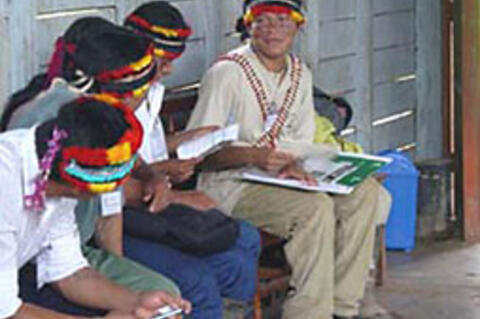
According to organisers, "[t]here are many tourism lodges that talk about involving the communities but they only hire local people to wash dishes. These are three cases in the Amazon with true community participation." Besides the participation of the local indigenous communities, the experiences have in common their location in difficult-to-reach sites in relatively pristine rainforest. The experiences - shared during in-person encounters - from one lodge in each nation include:
- Kapawi Ecolodge in Ecuador is administrated by the Canodros company with the participation of the Achuar Indigenous Federation, which unites 50 indigenous communities. The company provides a fixed monthly quota to the federation, and most of the hotel jobs are filled by members of the community. The business will pass completely into community hands in 2011.
- Posada Amazonas, in Peru, is a similar management model between a private company, Rainforest Expeditions, and the local community. This case involves the native community of Infierno, where the indigenous Ese'eja share their work with Ladinos and residents of settlements along the river. Sixty percent of the hotel profits are provided to the community, which will receive the business in its entirety in 2016.
- The Chalalan Ecolodge in Bolivia, a lodge that is already in community hands. The Quechua-Tacana people of Uchupiamonas community have a partnership with Conservation International, which orchestrated the transfer of the hotel to the community.
The experience exchanges were based on previously completed ethnographic research in the 3 sites, which was aimed at helping local leaders define what topics they wanted to discuss during the workshops. They articulated product strengths and weaknesses, partnership terms established for the hotels' administration, distribution of economic resources, the process of transferring the hotels into community hands, significant changes in the communities stemming from ecotourism, management of tourism resources (cultural and natural), and monitoring of the changes.
Participants are continuing to exchange lessons learned via radio in each community; having discovered that this radio reaches from Ecuador to Bolivia, they can now communicate across borders. They also hope to hold a fourth meeting in Ecuador about what they want to collaborate on in the future, such as attending international tourism fairs, exchanges among guides, and joint handicraft marketing.
Ecotourism.
Organisers reflect on the main lesson learned from the workshops:
- The transfer of the lodge is not necessarily the goal. The company has strengths, characteristics, and knowledge that the community does not have, and vice versa. Discussion about a plan to work together has been found to be an effective strategy for capitalising on the talents and knowledge of each side. A new model that came out of the workshops is that of non-governmental organisation (NGO), company, and community as a new partnership model. An NGO can attract resources that the community and the business cannot: for example, capacity for monitoring and training related to project impacts and the ability to raise funds for satellite projects. This entails focusing on health and planning projects in the community, using the resources generated by ecotourism, and thinking holistically about the development of the entire community.
- Ecotourism can cause conflicts, from the viewpoint of who is participating, who is not, and who should be. One conflict almost all members of indigenous communities emphasise is that working in tourism entails the difficult decision of leaving the community, their small farms, and their families. On the other hand, those who are very involved said they now feel they are working for their community and helping their families. Since these are community businesses, one difficulty has been the redefinition of relationships among the people and the situations that can crop up as a result.
- Ecotourism is changing the community dwellers' vision toward conservation. As organisers report, previously an NGO would come and talk with the local people about the need to protect natural resources, but the people either did not understand or they did not care. Now participants say that it makes sense to talk about how they are going to protect these resources, which will very concretely benefit them.
- Challenges have arisen, such as questions about who should be a partner: should everyone receive part of the earnings even if some people have never lifted a finger to help build the lodge? Are they entitled to earn something like everyone else just because they live in the community?
- Creating a feeling of ownership is a challenge (do the indigenous communities feel that the business is "theirs"?)
- The reportedly successful strategy of fostering cultural aspects that interest the tourists who visit is reflected in Kapawi, where community members speak their own language, wear traditional clothing, and truly maintain their culture.
- Regarding tourism management practices, organisers learned that it is very important to create rules and sanctions in common agreement with the community, so that everyone understands what the rules are and respects them.
- Efforts to measure the impacts of tourism over the long term are needed.
- Ecotourism has a positive impact in that the communities are in control, participating in the projects - learning how to manage a lodge and how to plan their future strategically through their partnership with the companies. The balance is that ecotourism is not the answer to all their needs, but it is one more option that can help them.
- Carrying out exchanges like these is valuable in terms of giving people opportunities they usually do not have to travel to international conferences, to realise that there are communities in other sites that are confronting the same problems and seeking solutions, and to see that among themselves they have many answers and don't have to depend on outside experts to resolve their problems.
Eco-Index® Stories from the Field, February 2004, an interview with Amanda Stronza, Director of the Amazonian Exchange, led by Katiana Murillo, Rainforest Alliance; and email from Amanda Stronza to The Communication Initiative on June 18 2010.
- Log in to post comments