










































University of Hyderabad - Masters in Communication
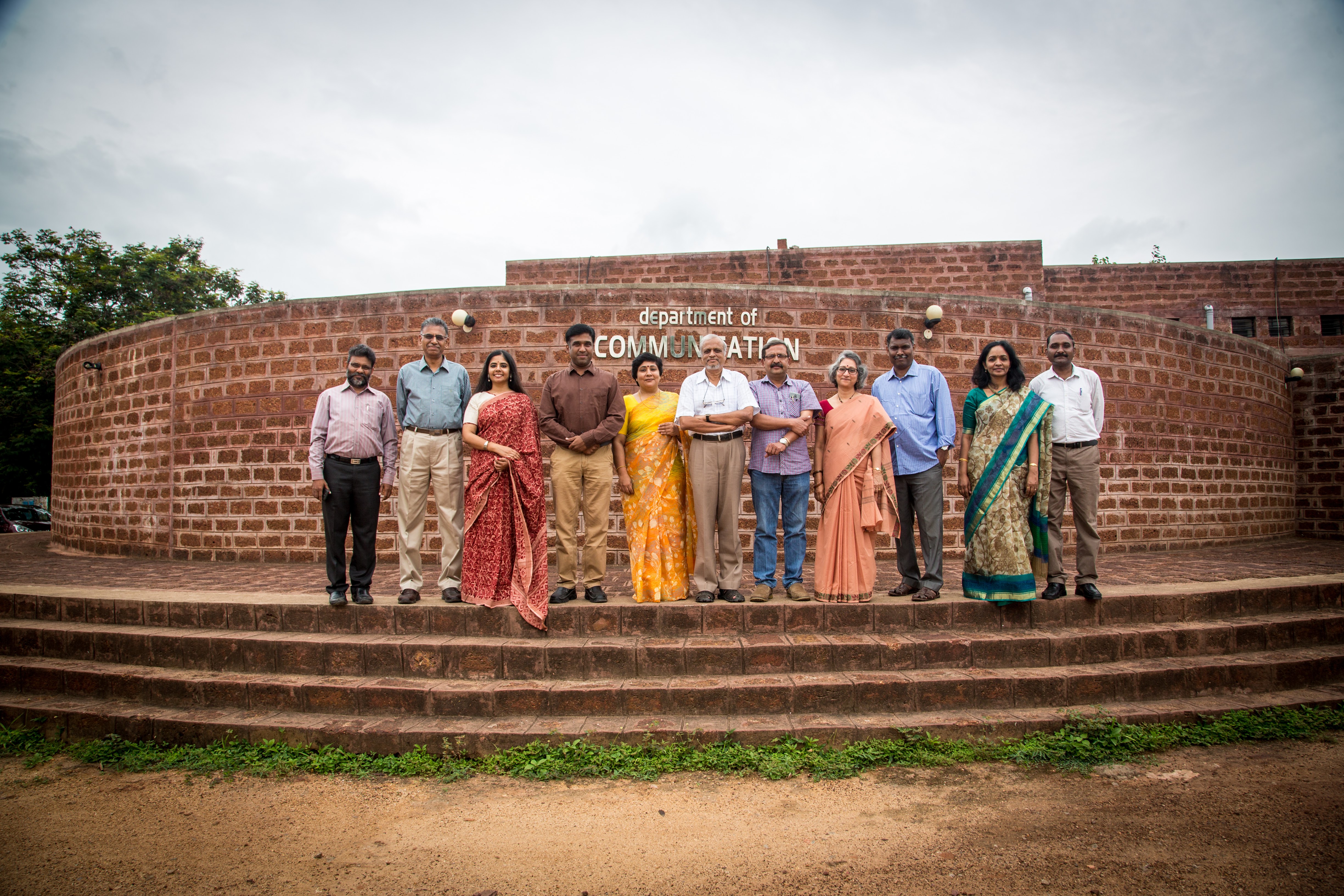
The MA Communication programme is offered in 3 streams - Radio & Video Production; Print Journalism & New Media; and Communication & Media Studies. Annually, 40 students are admitted through a nationally administered test followed by a personal interview with shortlisted candidates.
Click here for more information.
The students get exposure to a range of mandatory courses in the first two semesters, including both theory and practice-oriented inputs.
The theory courses are:
- Introduction to Communication;
- History of Media;
- Communication & Social Change;
- Communication Research;
- Media Laws & Ethics.
The practice-based courses are:
- Basics of Writing;
- Introduction to Radio Production;
- Introduction to Video Production; and
- Print & Web Production.
In the third and fourth semesters, students specialise in one of three streams: Radio & Video Production; Print Journalism and New Media; and Communication and Media Studies.
The Communication and Media Studies students typically have courses (some of which are cross-listed for other streams as electives) such as:
- Communication and Culture;
- Globalisation and Communication;
- Community Media and the Public Sphere;
- Science and Health Communication;
- Film Theory;
- Media Management;
- ICTs for Development; and
- Digital Media Cultures.
Print and New Media stream courses includes:
- Media, Conflicts and Calamities
- Feature & Analytical Writing;
- Reporting & Print Production;
- Specialized Reporting; and
- Approaches to Editing.
The Radio and Video Production stream includes courses such as:
- Documentary Production;
- Television News Production;
- Genres and Formats;
- Advanced Radio Production; and
- Advanced Video Production (Studio).
All streams have a major project requirement in the fourth (final) semester, including a Master's Thesis by the Communication and Media Studies students, a documentary film by the Radio & Video Production students, and a print portfolio and magazine production for the Print and New Media students.
Click here for more information.
The department also offers a PhD programme in Communication.
While classroom instruction in the traditional mode still constitutes the heart of the pedagogy, the department evaluates students on a wide range of assignments and projects, such as: oral presentations, term papers, radio and video productions, documentary filmmaking, writing for and publishing a campus newspaper and a magazine, writing for and managing online portals, and a Master’s Thesis (for those students who opt for the theory/research-oriented stream). The department seeks to produce not only graduates who become practitioners with a critical perspective, but also researchers and C4D specialists who are endowed with the practical skills required for a rapidly changing communication environment.
The following are a selection of readings for the Communication and Social Change theory course:
- Amartya Sen, Development as Freedom, Oxford University Press, 1999.
- Richard Peet and Elaine Hartwick, Theories of Development: Contentions, Arguments, Alternatives, 2nd Ed., Guilford Press, 2009.
- Linje Manyozo, Media, Communication & Development: Three Approaches, Sage, 2012.
- Srinivas Melkote and H. Leslie Steeves, Communication for Development: Theory and Practice for Empowerment and Social Justice, 3rd edition, Sage, 2015.
- Shirley White with K.Sadanandan Nair and Joseph Ascroft (eds), Participatory Communication: Working for Change and Development, Sage, 1994.
- Jan Servaes, Thomas Jacobson and Shirley White (eds), Participatory Communication for Social Change, Sage, 1996.
- Nair and Shirley White (eds), Perspectives on Development Communication, Sage, 1993.
- Britha Mikkelsen, Methods for Development Work and Research: A Guide for Practitioners, Sage, 1995.
The following are a selection of publications by faculty members:
Professor Vinod Pavarala
- “Social Constructions of Religiosity and Corruption,” Economic and Political Weekly, Vol.XLVII, No.1, 61-68 (2012) (with Kanchan K. Malik),.
- “Ten Years of Community Radio in India: Towards New Solidarities,” Guest Column, Educomm Asia, Vol.17, No.2, April 2013, pp.2-4.
- Communities are entitled to news The Hoot, October 21, 2013.
- Community Radio Continuous Improvement Toolkit, Version 2.0, New Delhi: CEMCA, October 2013 (Creative Commons License) (with . Kanchan K. Malik, Vasuki Belavadi, Aditya Deshbandhu).
- Trust deficit persists on news on community radio. The Hoot (with Bhat, R.) (2014, September 5).
- Towards an equitable policy on community radio. The Hindu Web Exclusive (with Bhat, R.) (2014, September 9).
- The long fight for low power FM in the US – In conversation with Pete Tridish; The Hoot, March 2015 (with Kanchan K. Malik)
- ‘Community Radio ‘Under Progress’: Resuming a Paused Revolution’, Economic and Political Weekly, Vol. L, No.51, pp 14-17, December 19 (2015).
Professor Kanchan K. Malik
- “Community Radio: eliminating voice poverty”, The Hoot, February 09, 2012.
- “Community radio in India: Codes of Practice can aid Self-Regulation”, In Vidura Vol. 4; Issue 4; October-December 2012 Page 49-51
- “Community Radio is the Answer: What is the Question?” AMARC Asia Pacific newsletter (Sept. 2012) Year 8; No. published by the AMARC Asia Pacific Regional Office, Kathmandu, Nepal Page 4-6
- “Community Radio: Guidelines on Management and Ownership” in “Ground Realities: Community Radio in India,” published by Communication and Information Sector, UNESCO, New Delhi © UNESCO 2011 ISBN: 978-81-89218-44-7 Page 23-26.
- Book Review: ‘Community Radio in the Twenty First Century’ by Janey Gordon (Ed) Publisher Peter Lang(2012) in EduComm Asia, a Newsletter of the Commonwealth Educational Media Centre for Asia (CEMCA) Vol.17 No.2 April 2013
- Radio programming for youth, by youth - please tune in. Vidura Vol. 7 (2), pp. 32-34. March 2015
- Community Radio and Women in India – Strengthening Participation and Voice. Vidura Vol 7 (3) pp 28-30 (June 2015).
- Our Media, Our Principles: Building Codes of Practice for Community Radio in India. Journalism Studie (Routledge) (August 11, 2015).
- Women in CR: Lessons from Mozambique - An interview with Palmira Velasco’, CR News, October-December (2015).
Professor Usha Raman
- Indian youth and social media: modes of engagement? In Wlnat L and Aw A (eds) Social media, culture and politics in Asia. New York: Peter Lang. 2014 (With Roshni Verghese).
- From social media to social action. In Rajan, N and Jayaram M (eds), Covering and explaining conflict in civil society. Hyderabad: Orient Blackswan. 2014 (With Sridivya Mukhpalkar).
- Performing the self online: transnational identity and blogging from domestic spaces. In Sahoo A and de Kruijf J G (eds), Indian Transnationalism Online. London: Ashgate Publishing. 2014 (With Sumana Kasturi).
- Have travelled, will write: User generated content and travel writing. In Fursich E and Hanush F, Travel Journalism: Exploring production, impact and culture. London: Palgrave Macmillan. 2014 (With Divya Choudary).
- Modes of engagement: creating reflective practitioners through engaged learning. The Journal of Development Communication 2014: 25 (1-2): 104-108.
- Research in the Biomedical Sciences, The National Medical Journal of India, pp 139-152 (2015).
- Failure of Communication, The Caravan, December (2015).
The department has 11 permanent/regular faculty members, with 10 of those holding PhD degrees. The faculty brings in a balance of theory/research and media practice abilities and skills. These include:
- Dr. B.P. Sanjay – Professor
- Dr. Vinod Pavarala – Professor & UNESCO Chair on Community Media.
- Dr. P. Thirumal – Professor
- Dr. Vasuki Belavadi – Professor
- Dr. Kanchan K. Malik – Professor – Head of the Department of Communication
- Dr. Usha Raman – Professor
- Dr. P. Kennedy – Associate Professor
- Dr. E. Sathya Prakash – Associate Professor
- Dr. Janardhan Rao Cheeli – Associate Professor
- Dr. Madhavi Ravikumar – Assistant Professor
- Ms. Anjali Lal Gupta – Assistant Professor
Click here for more information about each faculty member.
Background Information:
The Department of Communication was started in 1988 as part of the Sarojini Naidu School of Arts & Communication, which also houses the departments of dance, theatre, and fine arts. Students at the department study the process of mass communications from the perspective of mass communication theory, political economy, historiographical/ cultural studies and development. They also train in skill sets such as print and new media journalism, electronic media production, communication studies and, advertising and public relations. Right from the beginning the programme attempted to train students to understand communication for social change and impart media production skills that could be used to further that larger goal.
- Log in to post comments