










































Kids' TV Time Linked to School Woes, Bad Habits
Health.com
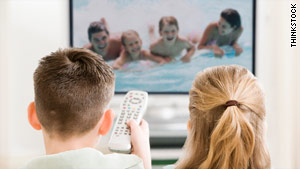
This article from Health Magazine (reprinted on the United States (US)' Cable News Network, or CNN), describes a Canadian study that found television watching to be a behaviour translating into poorer classroom behaviour, less physical activity, and more snacking.
Published in the Archives of Pediatrics and Adolescent Medicine, the study followed more than 1,300 children for over 7 years. Using parent surveys, the researchers measured the amount of TV watched at age two-and-a-half, and again at age four-and-a-half. Then, when the children were in fourth grade (age 10), the researchers asked the children's schoolteachers to rate their academic performance, how well they got along with peers, and how well they listened and followed instructions. They also asked parents about the child's diet and level of physical activity.
Each additional hour spent in front of the TV per week at age two-and-a-half corresponded to a 7% decrease in classroom engagement, a 6% decrease in overall math achievement, and a 10% increase in being bullied by peers. TV watching also appeared to have negative effects on physical health, with each additional weekly hour resulting in a 9% decline in overall physical activity, a 9% increase in soft-drink (soda) consumption, a 10% increase in snacks eaten, and a 5% increase in body mass index. The American Academy of Pediatrics recommends that children under the age of 2 watch no television at all, and after age 2 watch no more than 1-2 hours of quality programming per day. But nearly half of 1- to 2-year-olds and more than 40% of 2- to 3-year-olds are estimated to watch more than the recommended amount, the study notes.
The lead author of the study, Linda Pagani, Ph.D., a professor in the School of Psychoeducation at the University of Montreal, in Quebec, says, instead of sitting on the couch, "[k]ids should be doing things that are intellectually enriching: playing with board games, playing with dice, playing with things that will improve their motor skills, reading." Another theory is that the act of watching television can harm developing brains. One expert quoted here, Dimitri Christakis, M.D., explains that "[e]arly exposure to [television] can actually be over-stimulating for the developing brain, and that can lead to shorter attention spans [and] cognitive difficulties." He adds: "The hypothesis we have is that this conditions the mind to expect high levels of input, and by comparison, reality is boring - it doesn't happen fast enough."
Pagani also suggests another possibility: The negative effects of TV that have been reported in studies are in fact a symptom of broader family and household dynamics. Although Pagani and her colleagues controlled for these and other factors in their analysis, household habits can shape studies like this in ways that can be difficult to tease out.
Christakis (quoted above) points out that Pagani and her colleagues did not ask about the specific programming that kids watched, which may weaken the findings. He says that parents should distinguish between mind-numbing cartoons and educational programmes such as Sesame Street. According to Christakis, the best way for young children to watch TV is with a parent. This allows parents to use potentially negative content (such as violence or advertising) as a learning experience, and also provides an opportunity to engage with the children and reinforce the message of educational shows.
Health Magazine website, May 26 2010.
- Log in to post comments