










































Remarks by Executive Director Michelle Bachelet on First Anniversary of UN Women
UN Women
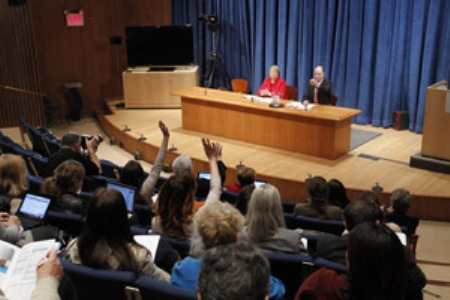
From a press conference in New York City, NY, United States, in February 2012, United Nations (UN) Women Executive Director Michelle Bachelet called for greater commitment and action for women and gender equality. Ms. Bachelet outlined the action agenda of the organisation for 2012. Focusing on two developments that occupied global debate in 2011 - the democracy movements in the Arab States and the continued financial and economic crisis - Ms. Bachelet highlighted the challenges that have emerged for women’s rights, as well as the opportunities, and the UN Women response to the changing geo-political scenarios.
Priorities from 2011 and for 2012 include the following:
1. Advancing women’s political participation and leadership:
- Establishment of the Egyptian Women’s Union, an association of 500 groups, and facilitation of the formulation of their demands in the Egyptian Women’s Charter, as well as a call for concrete proposals from governments and civil society in Arab States to support women’s political participation and empowerment.
- Support for women’s movements in 52 countries for women’s leadership; work with parliaments in 20 countries to amend laws to include gender equality; training sessions in 38 countries along with meetings for parliamentary and legislative techniques to advance women’s political participation; training for women candidates in 27 countries; and support for reforms of electoral laws in 39 countries to facilitate the inclusion of women in elections as voters and candidates.
2. Improving women’s economic empowerment:
- Support for countries to provide training and skills, increase access to markets, and make policies, laws, and conditions fair for women.
- Outreach to the private sector to gain commitments to the Women’s Empowerment Principles to advance decent working conditions and equal opportunities for women.
- Empowerment of rural women and initiation of partnership with the UN Food and Agriculture Organization, the International Fund for Agricultural Development, and the World Food Programme.
3. Ending violence against women and girls.
- Issuance of the report on progress for the world’s women, In Pursuit of Justice.
- Launch of a global policy agenda to end violence against women and an initiative to provide essential services to survivors, including support for governments, women’s groups and others in adopting laws and policies, raising awareness, and delivering services.
- Focus on making justice work for women, ending impunity, furthering prevention by engaging broad sectors of society, and ensuring services for survivors through more funding to intensify action and resources to end these human rights violations.
4. Expanding the role of women in peace talks, peace-building, and recovery.
- Finalisation of national action plans in Georgia, Serbia, and the United States to advance Security Council resolution 1325 on women, peace, and security.
- Support for women’s participation in international engagement conferences in Afghanistan and the newest Member State, South Sudan.
- Training of women in Africa and Asia to be mediators in conflict prevention, and peacekeepers' pre-deployment training to prevent and respond to sexual violence.
- Creation of a UN system-wide framework to increase coordination and accountability across the UN system for women’s participation in resolving conflict, building peace, and ending sexual violence, as well as agreement to allocate at least 15 percent of budgets for post-conflict recovery to ensure women’s participation and at least 40 percent of temporary jobs in post-conflict recovery to women.
5. Making budgets and plans benefit women and men equally.
- Building capacity in gender analysis and budgeting, and using sex disaggregated data for more equitable public policies and budgets.
- Working with UN Country Teams to expand gender responsive budgeting with the participation of women to achieve lasting institutional change.
6. Increasing coordination and accountability across the UN system for gender equality.
Click here and scroll to the bottom of the page to view the live webcast.
Press release from UN Women on February 2 2012.
- Log in to post comments