










































Using Social Network Analysis to Examine the Decision-Making Process on New Vaccine Introduction in Nigeria
International Vaccine Access Center (Wonodi, Privor-Dumm, Reis, Gadhoke, Levine), Solina Health (Aina), National Primary Health Care Development Agency of Nigeria (Pate)
"Stakeholders may have different levels of interest, knowledge and motivations to introduce new vaccines. Lack of consensus on the priority, public health value or feasibility of adding a new vaccine can delay policy decisions."
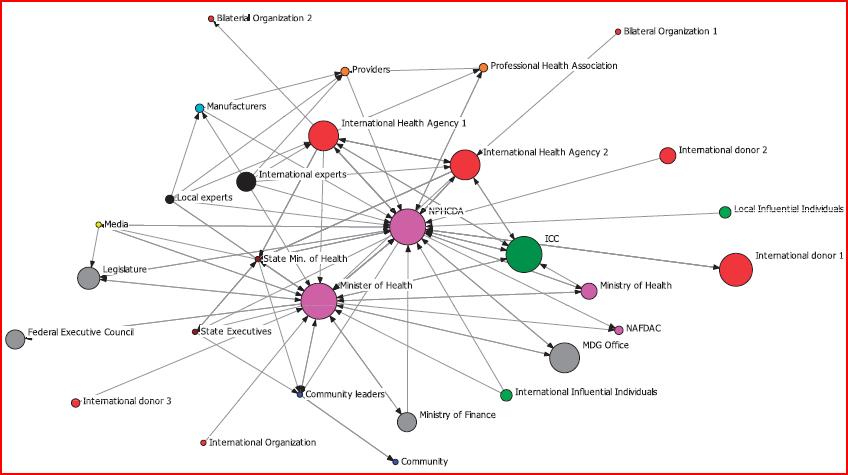
The introduction of new vaccines into a national vaccination programme is a complex process with many stakeholders and diverse interests. International Vaccine Access Center (IVAC) researchers used a social science technique called social network analysis (SNA) to examine the structure and relatedness of the network of actors involved in Nigeria's decision-making process. This approach can be used to identify how information is exchanged and who is included or excluded from the process. In brief, their results show a robust engagement of key stakeholders, while also identifying areas that may need strengthening through the central involvement of other stakeholders.
As explained here, in line with global, regional, and Millennium Development Goal 4 (MDG4) targets, Nigeria's immunisation goals are to attain 80% coverage of all antigens in 80% of districts, interrupt transmission of vaccine-derived and wild polio virus by 2012, and introduce Hib and pneumococcal conjugate vaccine (PCV) to fast-track reduction in child mortality by 2015.
This was a mixed methods study using qualitative [key informant interviews (KIIs)] and quantitative (survey) data collection methods. The researchers interviewed a total of 38 people: federal and state-level government officials, officers of bilateral and multilateral partner organisations, and other stakeholders such as health providers and the media. Using data culled from those interviews, they performed an SNA in order to map formal and informal relationships and the distribution of influence among vaccine decision-makers, as well as to explore linkages and pathways to stakeholders who can influence critical decisions in the policy process.
Through text and diagrams, the paper explores: the network composition (the vaccine introduction network, the vaccine programme implementation network, and types of roles actors play in vaccine decisions); relational ties; and perceived influence.
The study has 4 main findings:
- The network of policymakers (involved in decision-making about new vaccine introduction, or NVI) is diverse but highly centralised around 2 entities: the Minister for Health and the National Primary Health Care Development Agency (NPHCDA). Other stakeholders playing a role include governmental organisations, international organisations, state and local governments, non-governmental bodies, community leaders, and the media and others.
- The 2 groups of stakeholders who are critical to making financing decisions and driving programme implementation were not well connected in the network, and in the case of the implementation actors, were also perceived to have low influence on the policy process. "Integrating the state and local government actors into the policy process earlier could improve implementation. Engaging states in the decision-making around NVI may motivate them to improve service delivery and mobilize communities around new vaccines."
- "[A]ll international donors appear peripheral and minimally influential, with the exception of one health sector donor who was perceived as highly influential but observed to have only one connection in the network."
- Community leaders, civil society organisations, the media, and the manufacturers "play a minimal role in influencing vaccine decisions and were peripheral to the process. The recent experience with polio in northern Nigeria demonstrates the significant social influence of religious and traditional leaders....[A]s an institution they can aid health programme managers in mobilizing communities and raising public support for immunization. Vaccine programmes can benefit from engaging religious leaders in discussions about the needs of their community and how to best meet them. These leaders should also be equipped with information; seminars and training may help them perform as an information bridge to the community."
The researchers conclude that SNA can be a helpful strategy in facilitating the work of decision-makers to shape policy and programmatic strategies to deploy information, influence, and/or advocacy to the actors whose engagement and action can facilitate NVI. In the Nigerian context, the findings suggest that efforts to foster interactions and exchange among, and advocacy directed to, specific policymakers may strengthen decision-making by optimising the influence and resources from all network members, ultimately accelerating vaccine adoption.
LinkedIn Network Updates, July 25 2012. Health Policy and Planning 2012;27:ii27–ii38.
- Log in to post comments