










































Making Waves: WAN SMOLBAG
Stories of Participatory Communication
for Social Change
TITLE: The Wan Smolbag Theatre for Development
COUNTRY: Vanuatu, Solomon Islands
FOCUS: Health, AIDS/STDs, environment, Governance
PLACE: Vanuatu, Solomon Islands
BENEFICIARIES: General population of Melanesian Islands
PARTNERS:
FUNDING: British Development Cooperation (DFID), United Nations Fund for Population Activities (UNFPA), United Nations Office for Project Services (UNOPS), New Zealand Overseas Development Agency (NZODA), Australian Agency for International Development (AusAID), Foundation for the South Pacific (FSP), UNICEF, Save the Children
MEDIA: Theatre, video, audio-cassettes
Another rainy day at Wan Smolbag house in Vila. It should be the dry season, but it feels like the sun hasn't shone for weeks! The rain has forced everyone inside the building and that makes things a bit cramped. There are ten extra actors from Tagabe as well as 11 full-time Smolbag actors for the 20-episode radio soap opera called Sarah's Family about reproductive health topics, produced with funding from Oxfam, New Zealand. The young part-time actors sit around reading their scripts and periodically disappear off into the radio studio at the back.
The building is rather full today as another two of the Smolbag associate groups are in rehearsal before heading off for island tours. Wan Smolbag Kids is going to the island of Santo to perform plays around children's rights and reproductive health in schools and communities. Health Force Theatre, an older group from the Blacksands settlement, is also ready to go on tour to Tongoa. They are having a final run of Louisa's Choice, a play about domestic violence. The play ends with the actors saying that it is "always wrong to beat your wife"; they then put down three cards reading "agree, disagree, don't know"; so the audience will choose the card they agree with. The discussion usually goes on for hours. An actor goes off to check the flights and comes back very upset: the plane can't land on Tongoa as the grass is too high. They will have to wait a few days and see if anyone cuts the grass.
Later in the day a bus drives round to the side of the building and a group of women rush past the open double doors through the rain and on to the "Youth Drop in Centre" at the back. The women are brought from surrounding settlements to the centre to learn about family planning and reproductive health. Luckily the radio soap has finished early today, and a group of Wan Smolbag actors is free to perform the STD sketches for the women. These sketches are like walking biological diagrams that show how STDs spread and what they do in the body. At the end of the session the women ask the nurses all kinds of questions, ranging from how twins are made, to why some STDs make men sore when they urinate. The nurses are relieved when it is time for tea and they can hand' round fruit and sandwiches!
Written by founder Jo Dorras.
In 1989, fifteen voluntary part-time actors organised an NGO to work with communities on social and environmental issues in Vanuatu. The group called itself Wan Smolbag (in Bislama, the language of Vanuatu), because they wanted to show people that a theatre group could go anywhere. With only "one small bag" to carry a few costumes, the troupe was ready to produce plays on health and environmental issues and travel to the most remote villages within the Pacific Islands.
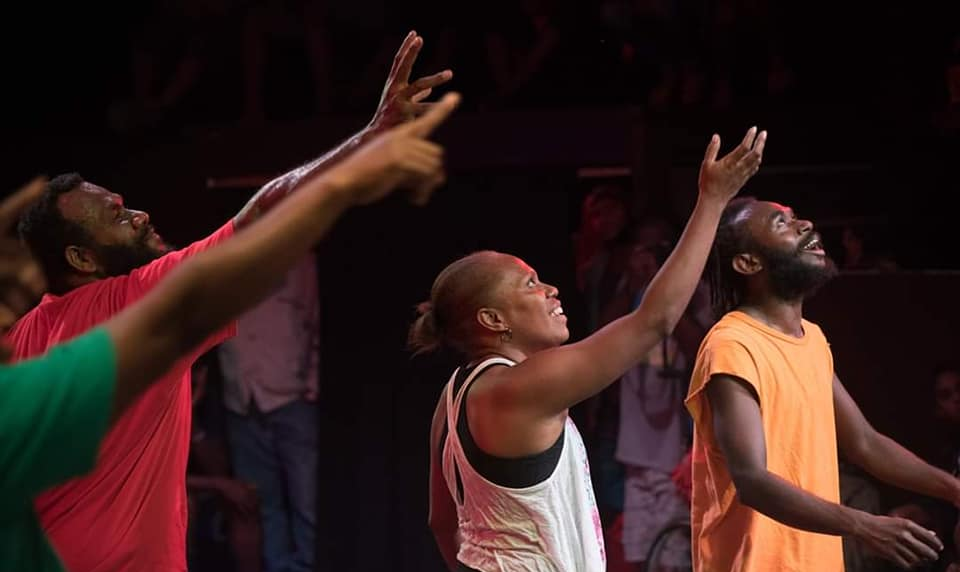
Wan Smolbag has written and produced a large number of plays, drama sketches and participatory drama workshops about environmental, health, social and human rights. The troupe has developed plays with science messages and animated dramatic sketches with messages and information involving audience participation. They perform their pieces throughout Vanuatu and the Pacific Islands, using plays and participatory drama workshops to disseminate information and create debate at the grassroots level. The mainstay of the group's work is a set of short 20 to 50 minute theatre pieces on environmental, health, governance and population issues. Performing in remotevillages gives the group the opportunity to stay the night and discuss issues in detail after the play.
The group has been core funded by the United Kingdom's DFID for six years and is well known in the informal education sector throughout the Pacific. Over the last four or five years Wan Smolbag has worked more and more with disadvantaged sections of society in Port Vila and the islands of Vanuatu. Many of the issues raised by people are in the areas of good governance: lack of services, ignorance of their rights, beatings in school, beatings by police, domestic violence, and women having no share in decision making.
Wan Smolbag Theatre has been working in the field of health education since 1989. Since that time the theatre has covered many different health topics. The main focus of its health work has been in the area of reproductive health, looking at the problems of teenage pregnancy, maternal health, STDs and HIV/AIDS. Plays are often aimed at a specific age group, and there are plays specifically for urban and rural audiences. About 50 plays have been produced since the beginning.
Wan Smolbags first foray into good governance work was in 1993. The group was commissioned to produce and perform a play on Children's Rights for UNICEF at the then South Pacific Commission, to raise discussion on the Convention of the Rights of the Child, which the Commission was asking member countries to endorse.
While person-to-person live theatre is the most effective way of getting a message across, sometimes there is a demand for other media. In addition to the plays, books, radio programmes and videos using live actors and puppets have been produced to reach a wider segment of the public. Among the video productions: George and Sheila looks at the role of men and women in Melanesian society. Pacific Star is a comedy with music, but deals with development issues in a powerful way. Things We Don't Talk About (1996) is a film on disability. Politics, Corruption and Voting is a film about corruption and politicians. On the Reef (1995)an amusing, poignant musical looks at marine life under threat. Kasis Road (1996) is a video on population and family planning. It Couldn't Happen Here (1998) shows where mosquitoes breed and how the Dengue virus spreads. Wan Presen Blong Niufala Bebe (tells the story of Malaria through live actors and puppets. Vot long Pati la! (1999) is Wan Smolbags new video on good governance issues.
Theatre is particularly popular because of the number of languages that are spoken in Melanesian countries. Vanuatu has over 9 languages; the Solomon Islands over 100 and Papua, New Guinea, had over 800. Nonetheless, Bislama, which started out as a communicative quick fix between monolingual English speakers and multilingual Melanesians, continues to serve important instrumental purposes in Vanuatu. The bulk of the programming on radio, the most democratic of the mass media in the country, is conducted in Bislama.
Wan Smolbag Theatre was started by Jo Dorras and Peter Walker as a health education initiative supported by the Vanuatu Health Department. With help from Community Aid Abroad and British Aid they set it up using community theatre to convey messages about health issues, and later expanded beyond Vanuatu to create a regional programme.
Wan Smolbag Theatre has been involved in exciting developments, which are a spin-off from its theatre work, and from the strong relationships they have built up with some communities.
In 1995 a series of workshops with children who were not atschool resulted in Wan Smolbag Kids. The group members range in age from 11 or 12 to 16. They perform plays aimed at primary school children on dental hygiene, dengue fever and on how the body works. A core group of nine children became a semi-permanent attachment to Wan Smolbag Theatre and appear in plays and videos.
Wan Smolbag Theatre spent six months during 1997 working closely with the Blacksands and Tagabe Community. A community play, which intended to build stronger ties with the older people, resulted in the Blacksands Community Project. The eldest of the participants was in her sixties and the youngest about ten.
Wan Smolbag Theatre had been doing plays on reproductive health for ten years, targeting different audiences. The response has always been enthusiastic but the question remained: what if people have all the knowledge and overcome the shame, but the local clinic has orders not to give contraception to single people? Or if the nearest supply is a long way away? That is how the Kam Pussem Hed (Youth Drop-in Centre for Reproductive and Sexual Health Clinic) was created in February 1999, with funding from DFID, NZODA, AusAID, SPC and UNFPA.
Another spin-off initiative, the Turtle Monitor, is driven by a group of interested people who were chosen by their village to help with the Wan Smolbag turtle campaign. They watch for nesting turtles and advise people on turtle conservation. The network started in 1995 following a play on that very subject. This has led to most villages banning the eating of turtles and their eggs. What started out as a network of monitors in the island of Efate, has now expanded to five more islands.
The Electoral Commission of Vanuatu wanted to inform as many people as possible about their voting rights when a snap election was called in 1998. Wan Smolbag created a play with actors from many different islands and seven groups of five actors were sent out. About 9 percent of the villages in Vanuatu saw the performance. It was a short play so there was time to discuss issues after. Many people said that before the group came they had decided not to vote, but after seeing the play they realised how important voting was.
We are one acting as many. We are many acting as one.
In Vanuatu there are many people who do not read or write, many who have had only a couple of years of schooling. These people want information, but they have no way of getting it from books; the radio does not reach everyone either, as people do not always have radio sets and if they do, they cannot always afford batteries. People in the villages say the plays make things clear, they can understand the message.
Wan Smolbag Theatre has developed a model of popular theatre that explains to people at the grassroots level about environment, governance and reproductive health issues. The group has developed sketches, showing how diseases like gonorrhea are transmitted through sex. They have developed a lot of what they call "moving biological diagrams" in which actors run about dressed for example as sperm and eggs. The sketches are in very short sections, lasting no more than about 3 seconds. After each sketch the audience is invited to explain what they have just seen and to answer questions. The action stops and the performers address the public provoking a discussion. There is one play where the performance stops to ask the audience what should happen next. Depending on the questions, the process can take up to an hour.
Wan Smolbag in Port Vila has two full-time nurses to provide support. A reproductive health clinic has been set up attached to Wan Smolbag Theatre; it provides videos and other health education resources.
In the participatory drama workshops people aged 11 to 70 played drama games, engaged in role playing, worked on sketches and told stories, which formed the basis of the play they went on to perform.
Probably the most obvious obstacle faced by Wan Smolbag Theatre in its work on health issues, is that they provide information about sexually transmitted infections, but if the health professionals do not want to give out condoms to young people, the plays will have no further effect. Traditions can also be an obstacle, along with certain religious groups.
One of the challenges is to keep the work fresh and not to run the same plays for too long. The theatre group has found new and innovative ways of giving the same messages through different plays. The styles of the plays change to make the message seem new. Wan Smolbag keeps assessing the impact of their activities, trying to improve performances and content.
Yet another challenge is to find enough funding to keep Wan Smolbag going. Being a large employer of youth in a country where unemployment runs at 70 percent is a big responsibility. We have managed so far, but some donors choose to fund big tendering organisations rather than in-country groups, which can make life very hard and make your blood boil too! says Jo Darras.
E-mail exchanges with Jo Darras and Peter Walker, founders of Wan Smolbag Theatre.
Wan Smolbag Theatre website
Continued...click here to return to the Table of Contents.
Comments

- Log in to post comments