










































Global Handwashing Day
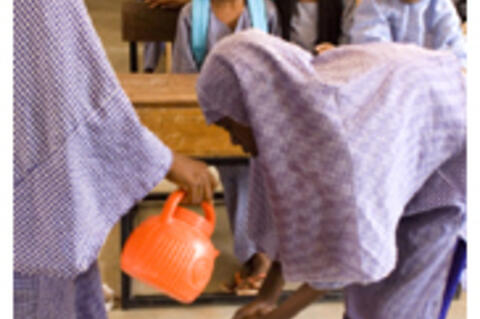
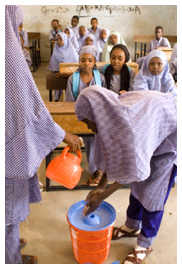
This initiative draws upon a number of approaches revolving around children's participation in an effort to transform handwashing with soap from an abstract good idea into an automatic behaviour performed in homes, schools, and communities worldwide. During Global Handwashing Day – and the surrounding week – playgrounds, classrooms, community centres, and the public spaces of towns and cities are the site of educational and awareness-raising activities as countries unite to change handwashing behaviour.
In 2008, more than 120 million children in 73 countries across 5 continents participated in the campaign; details on individual country activities may be found here. In 2010, over 200 million people were involved in Global Handwashing Day celebrations and over 700,000 schools celebrated the day. To cite a few brief examples, washing hands was the topic of Afghan television and radio talk shows and Pakistani newscasts. Nepal's new Maoist government sent out mobile text messages and, in Bhutan, special animated videos were made with Bhutanese characters. Planning personnel were invited to use resources available on the Global Handwashing Day website, such as the second edition of the "Global Handwashing Day Planner's Guide (2nd edition)" (scroll down), which is available in several languages.
Here is a more detailed description of activities undertaken in one particular country - India - in one particular year: 2008. Ministers at national and state levels launched the campaign by participating in handwashing activities with children in rural schools. These activities included: children pledging towards hygiene, organised handwashing games, and washing hands in a giant waterfall. Almost 1 million schoolteachers took part in training courses to execute the campaign and to reach out to about 100 million school children. Materials developed included: posters, teacher training module on handwashing, pamphlet with pledge for students. The mass media campaign was held with the support of Sachin Tendulkar and Yuvrag Singh, two "hugely popular cricket celebrities". A cricket event was held on the Mohali Cricket grounds in Chandigarh, where children joined the cricket team in demonstrating and taking part in correct handwashing procedures. Tendulkar also appeared for free in a public service announcement (PSA) developed by UNICEF and the Government of India broadcast in 14 languages on television channels across the country (click here to view the PSA). Radio jingles featured a 25-second song on the 5 steps for correct handwashing.
Global Handwashing Day messaging is strategically tied in with health events/threats that are (or should be) prominent in public consciousness. For example, the second annual Global Handwashing Day (October 15 2009) sought to draw attention to the importance of handwashing with soap for preventing the spread of germs and illness such as H1N1 influenza. These messages were thought to have particular resonance in light of the concern about recent outbreaks of H1N1 influenza, and recognition that (per USAID) "the likelihood that an emerging infectious disease will spark a global pandemic remains a significant threat."
Health, Children.
Millennium Development Goal (MDG) #7 aims to reduce by half the number of people without access to sanitation by 2015. According to organisers, of the approximately 120 million children born in the developing world each year, half will live in households without access to improved sanitation. Poor hygiene and lack of access to sanitation together contribute to about 88% of deaths from diarrhoeal diseases, accounting for 1.5 million diarrhoea-related under-five deaths each year. (For additional statistics and links to a Global Handwashing Day video and other resources, visit the USAID website.)
Data from India: According to the Public Health Association, only 53% of people in India wash hands after defaecation, 38% wash hands before eating, and only 30% wash hands before preparing food. Almost half of the people around the world without a toilet live in India, and nearly half the population of South Asia has no access to toilets. Practicing open defaecation creates an environment in which diseases can transmit easily. One gram of faeces alone can contain 10 million viruses, 1 million bacteria, 1,000 parasite cysts, and 100 parasite eggs. Diarrhoea and respiratory infections are the main cause of child deaths in India; more than 1,000 children die every day in that country from diarrhoea. Proper handwashing with soap can reduce diarrhoeal cases by 47% and acute respiratory illnesses by 30%. Providing private and separate sanitary latrines in school can increase girls' enrolment by 11%. Currently about 65% of Indian schools have sanitation coverage, with only 34% of girls completing their schooling.
UNICEF, USAID, CDC, the World Bank Water and Sanitation Programme, Unilever, and Procter & Gamble.
Star Cricketer Sachin Tendulkar Promotes Handwashing in India", by Angela Walker, October 16 2008; Indian Cricket Star Sachin Tendulkar Goes to Bat for Better Hygiene through Handwashing, by Angela Walker, October 8 2008; and Millions Mark UN Hand-washing Day, BBC News, October 15 2008; email from USAID to The Communication Initiative on October 15 2009 and September 12 2011; and Global Handwashing Day website.

- Log in to post comments